This week on my blog I’ll be sharing with you almost everything I know about writing. I’m holding out on a couple of things because I like to pretend to be mysterious and it’s fun having a secret. But I’m not actually very good at keeping secrets and I’m much too clumsy to be mysterious (because mystery, in my mind, involves long flowing cloaks and shadows and silence, not untied shoelaces and elbows whacking doorframes and shrieks of pain) so I’m sure I’ll cough up the last few useful tidbits soon. For now, though, I’m offering you ten writing tips over the course of five days which, in my opinion, is a pretty good deal.
You may be asking yourself, What makes her an expert? It’s okay, go ahead and ask it out loud. It’s a good question. The answer is nothing. Nothing makes me an expert. I’m not an expert; I’m just a writer. But I’ve been doing this writing thing for two years now, and in that time I’ve had a little success and I’ve learned a whole heck of a lot. And one of the things I’ve learned is that I have to learn things over and over again.
It’s not that I’m a poor student. In fact, I’ve always been a very good student. But real learning takes time and retention takes repetition. If I’d truly absorbed everything I’ve learned over the past two years about the writing life, I’d probably be fiendishly typing 20,000 words a day and cranking out a bestseller a month by now* but I’m not, so the learning continues.
Another thing I’ve learned (you’re getting a couple of pre-tips here) is that a writer who’s stuck can be very skilled at forgetting the very things that would get her unstuck. It’s amazing how stubborn my brain can be. It will deliberately choose to ignore the simple, effective tools it has stored away in its grotesque** little folds when it’s determined to be stuck. I often have to be reminded to do things that I’ve been doing for years, things that I taught others to do for years, like…free writes. And timed writing. And quick character sketches. Every time someone recommends one of these things to me, I say, Oh yeah.Duh! Then I push my brain out of the way and get back to work.
My point is that none of the tips you’re going to see this week are earth-shattering ideas or light-bulb-over-the-head epiphanies. They’re just things that I’ve learned that I want to share. You’ve probably heard them before, but it doesn’t hurt to be reminded once in a while. Just distract your brain with a logic puzzle or one of those images of a snake eating itself so that you can read at your leisure.
Oh, and since I’m really not an expert***, I’ll throw in a few links to some people who actually know what they’re talking about as a bonus.
* I’m kidding. That is not actually what success looks like and it doesn’t sound healthy at all.
** Your brain may not be grotesque, but I’m pretty sure mine is.
Seventh graders are impressionable little things. That’s why you have to be careful how you handle them.
2010 was the year I got married. It was the year of WikiLeaks and royal engagements and the Chilean miners’ miraculous survival. It was the year Lost finally ended.
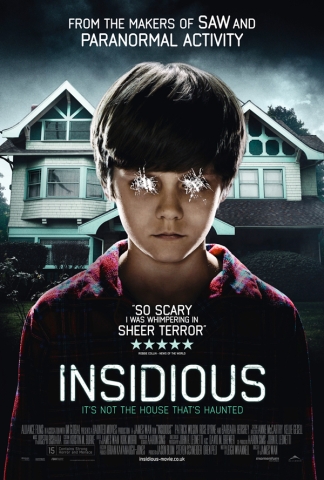
It was also the year the PG-13 horror movie Insidious hit the big screen.
I taught a really good group of students during the 2010-2011 school year. That was back when my district still had blocked classes for Language Arts, which meant I saw all of my kids for ninety minutes every day. There were only sixty of them that year, divided into ideal class sizes of twenty each, so I was able to really get to know them. They were good kids and a lot of fun.
My after-lunch class had a lot of personality. They were a very talkative, very friendly bunch, and many of them possessed that rare ability to get their work done while socializing. You can only fight that superpower for so long—eventually you have to admit that yes, they are really working while talking, make peace with it, and save your “I’m serious” speeches for test days and principal visits.
My after-lunch class’s feet on crazy sock day. Their personalities were just as unique.
During the second semester, the sidebar conversations meandered more and more to the subject of this new horror movie that just came out—Insidious. The talk was all about who’d seen it and who hadn’t and who had to cover his eyes and how scary it was. One popular boy, who we’ll call Patrick, just went on and on about it. The movie terrified him, but he kept going back to see it again. Patrick had watched the thing at least three times when he and his friend “Mike” started trying to talk me into seeing it. Patrick had a cute/exasperating inability to form a complete sentence when he was excited, so his persuasive techniques resulted in arguments like, “Ms. Juettner, seriously, I mean, oh my God, it’s just so, so, AAAAA!, and in this one part, oh man, oh man, Ms. Juettner, you’ve GOT to see it!”
Eventually I decided I’d better see it, so I made my husband go with me.
Now, before you start rolling your eyes and saying Insidious wasn’t scary, you need to realize something. These were thirteen-year-olds, and a lot of them were very sheltered thirteen-year-olds. I’m sure some of my students had been watching zombie movies with their older siblings since they were in the third grade, but some of these kids parents’ took the PG-13 rule seriously. The kids in my after-lunch class that year were a young group and for many of them, Insidious was the first horror movie they’d ever seen. Coming from that perspective, I’m sure it was truly horrifying.
I wasn’t horrified by Insidious. (Then again, I saw Poltergeist when I was much younger than they were, and it’s a much more scarring experience.) But I was entertained by it, and it did make me jump a few times.
One of the creepy parts of Insidious has to do with this old woman who stalks one of the characters in photographs. In every photo taken of him, ever since he was a little boy, the woman in black is visible, and in each picture she is getting closer and closer to him. Patrick and Mike were especially freaked out by this part of the movie. Patrick’s incoherent rants included a lot of, “Oh, and the old woman, oh my God oh my God, she… AAAAA!”
The old woman from Insidious
When you’ve had a good year, when you’ve taught kids who you genuinely care about, not just as students but as people, when you’ve developed real bonds with them, the last days of school can be bittersweet. Yes, it’s a time of excitement and looking forward to summer vacation, but it’s also a time of sadness and loss. A time of growing up and letting go. And, if you’re pretty sure their parents aren’t the litigious types, a time to have a little fun with them.
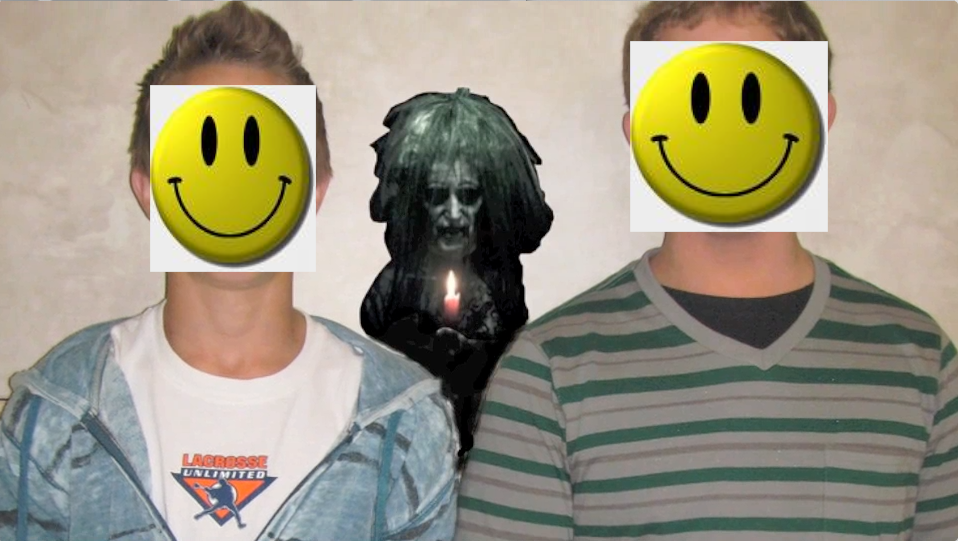
During the last week of the 2010-2011 school year, my kids were working in groups creating infomercials for the random and ridiculous products they were selling. (A few weeks earlier, I’d asked my classes to write down three objects they would never want to own and said, “Be creative.” I did not tell them why. Then I collected the slips of paper and put them in a bucket. Now the kids had been forced to draw a random paper out of the bucket and attempt to sell the items listed using the persuasive techniques we’d been studying. My students were advertising everything from a purse made out of earwax to a dead body. By the time all was said and done, there was very little educational value in the project, but the iMovies they created were hilarious.) While they worked on their commercials, I took photos of all of them for a class iMovie we were making as an end-of-the-year souvenir. Since some of the kids were shy about having their picture taken, I let them pose with a friend or two. Naturally, Patrick and Mike paired up.
Now comes the confession part.
I just couldn’t help myself. I mean, it was too easy, too perfect.
The kids all wanted to see each other’s pictures and the pictures from the other classes, so I told them I’d show them all the next day on the overhead projector IF they got all of their work done. That sent them scurrying back to their group projects. These kids were self-sufficient. They were on task. They really didn’t need me.
So… I spent about an hour and forty-five minutes of my contract time downloading pictures, creating a Sumo Paint account, and learning how to Photoshop an image. Two hours later, my masterpiece was complete.
The next day, the little darlings in my after-lunch class got all of their work done early, so, as promised, I started showing them the pictures. They oohed, they ahhed, they giggled, they teased each other about the faces they’d made. So innocent.
Then I got to Patrick and Mike’s photo and, before showing it, I paused. I looked at them.
“Patrick,” I said, “you and Mike’s picture came out a little… weird.” I raised an eyebrow.
“What do you mean?” Patrick asked.
“What happened to it?” Mike asked.
“I’m hoping YOU can tell ME,” I said and stared at them pointedly, shaking my head and rolling my eyes. I went to click the button to show the picture but paused one more time, my hand poised over the mouse. “I really don’t know how you guys did it,” I said, “but you better not have used my computer without my permission.” One more pause. One more glare. The class was quiet. I clicked the button.
And there, on the screen was Patrick and Mike’s photo, with the old woman from Insidious peering out right between them.
There was one second of silence before an enormous GASP erupted from Patrick, who stood up and launched into the most incoherent of all of his ramblings. Soon though, his babbling died down into a single continuous stream of “No no no no no no no no no no no no no no.”
Mike’s reaction was more subdued. He smiled a little. Then he frowned a little. Then he said quietly, “You did that.” And when I didn’t answer, he squeaked, “Did you do that?”
I didn’t make them suffer long. The rest of the class was going crazy and I didn’t want the noise to bring any concerned principals into the room. I wasn’t itching to explain the image on my screen. The prank had worked beautifully though. In my opinion, those were hours well spent.
Seventh graders are impressionable little things. That’s why you have to be careful how you handle them. I guess Patrick and Mike would be in tenth grade now. Maybe I should look them up, see how they’re doing. I’m 70% sure I didn’t do any permanent damage to them. Regardless, I have no regrets.
[To read more stories from my teaching career, check out my Teaching Stories page.]
A few months ago, I discovered a cool cigarette-machine-turned-art-machine at my local Whole Foods store and promptly broke it. (It was an accident, I promise.) Since it didn’t work, I didn’t get to find out what sorts of treasures awaited inside.
This week, I went back and was delighted to find the sad little “out of order” sign gone. I decided to try my luck again, and this time it worked! (Which is a relief because I didn’t want to to tell the nice guys at Whole Foods that I broke their machine again.)
Which treasures did I choose?
Why, slug soap and monsters, naturally.
Monsters = no brainer. I like monsters. I also think slugs are pretty cool when I am not stepping on them or trying to keep my dog from eating them. The slug on this package reminds me of the large plastic slug that I found and made into a necklace for my good friend Emily. (Yes, of course she liked it. Why do you ask?) I couldn’t resist seeing it in soap form.
I was so excited to find out what was inside these cigarette-pack-shaped boxes that I opened them up in my car. The advertising did not lie. I got a monster and slug soap.
The monster is a little weird. Ok, they’re both weird. But the monster is more weird because I’m not sure what to do with it. At first I thought it was a magnet, which would have been cool, but no. It’s just a tiny painting of a vampire (with a side of Dracula trivia). I think this one is destined to become a stocking stuffer. (Get ready, friends and family! Any one of you could be the lucky recipient!)
The slug soap is, in my opinion, much cooler and also quite practical. I look forward to washing my hands with this little guy and watching him melt away like he’s been salted. (Don’t do that to real slugs! It’s mean!)
So, mystery solved. What’s inside the weird art machine? Weird art. Its existence makes me happy.






 Carie Juettner