Psst! I have a secret. Lean close so I can whisper it in your ear. I still don’t quite understand the lines between Middle Grade and Young Adult, which is bad because I’m writing one of them. I think. But more about that in a minute.
The Pleasure of Browsing
A few days ago, I went to Barnes & Noble to look for some books about writing that had been recommended to me in a weekend workshop from the Writer’s League of Texas. I do not like shopping for writing books at Barnes & Noble. I am not a fan of their “organization” (a term I use loosely here) of that particular section of their store. But a nice man who works there, who is also a writer (we are EVERYWHERE), very kindly helped me find no books, by which I mean the books were not there to be found. Ce la vie. So, unable to leave a book store without a book, I started browsing.
I currently have 55 books on my “To Read” list on Goodreads, and it continues to grow at an alarming rate. But most of those books are books that I think I “should” read, or books that have been recommended to me by other people, or books that I already own and really (really!) want to get around to reading some day. These days, with so many volumes waiting in the wings, I rarely just “browse and buy” anymore, and I had temporarily forgotten what a wonderful feeling it is to pick up a book, look it over, read a few pages, and put it down… or not. It’s such a nice moment when you don’t put it down. Or when you do, but then you find yourself wandering back over to pick it up again. For me, finding an unexpected book that I can’t put down in the bookstore is one of those time-stopping moments when everything around me disappears and the importance of my to-do list slowly dwindles, and I realize, with a smile, that I’ll be reading all afternoon.
Book Review: I Kill the Mockingbird
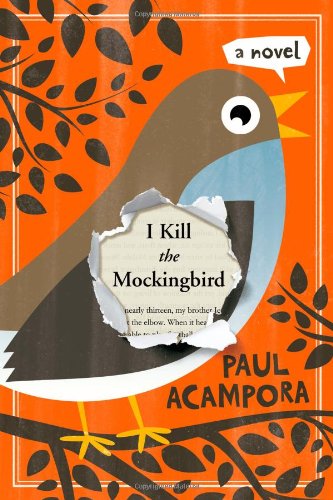
I walked out of Barnes & Noble with Paul Acampora’s I Kill the Mockingbird because it met all the requirements of a time-stopper: I loved the cover. I loved the blurb on the inside of the jacket. I loved the chapter titles, such as “The Queen of England is in Our Bathroom” and “Jesus, Ginger Ale, Norse Gods, and Weiner Dogs.” And I loved the first page. As added proof of this book’s worthiness as a “browse and buy,” I continued reading it as I walked up to the check out counter and stood in line. And as further, subsequent, ADDITIONAL proof, I walked to my car with a theoretical lightbulb over my head because something in the first few pages of Acampora’s novel gave me an idea for how to fix something in my own. An important reminder for any writer: You don’t always need books about writing to show you how to write. All great books teach us to be better writers.
I Kill the Mockingbird is about three life-long friends who love books (especially the classics) more than most kids their age. (Some might say this makes them unbelievable, but I say it makes them interesting.) In an effort to honor the memory of their late, favorite teacher (Fat Bob) by getting as many people as possible to read Harper Lee’s To Kill a Mockingbird, they embark on a sneaky summer project that doesn’t quite break any laws, but definitely gets them into a bit of a pickle when it becomes much bigger than they ever imagined. The story moves right along, and all of the characters are lovable, with well-rounded back stories. Acampora’s novel includes strawberry peeps, literary terrorists, and some fun teenage banter. What’s not to like? I gave it 4 solid stars on Goodreads.
Now the Confusing Part
Ok, back to my secret confession.
I’m writing a young adult (YA) novel. I’m pretty sure. Several months ago, however, I started paying closer attention to this other subset, middle grade (MG), and I started to wonder, AM I writing a young adult novel? So I set out to determine the difference.
And it wasn’t so easy, let me tell ya.
The starting point for differentiation is age, but not the age of the character, the age of the reader. I read more than one article which began with the simple definition that MG is for readers 8-12 and YA is for readers 13-18. The first problem here is obvious: What if my readers are 10-15? So the articles then begin to discuss the more subtle dividing lines.
However, the more I read, the more I felt like I was wading into a fog. Because the truth is that very few of the lines between MG and YA are black and white. For every rule I learned, I came across at least two exceptions, until I saw fewer and fewer thin black lines and entered wider swatches of gray.
The following chart contains certain “guidelines,” as we’ll call them (since “rules” seems like too strict a term) that I gleaned from the following four sources:
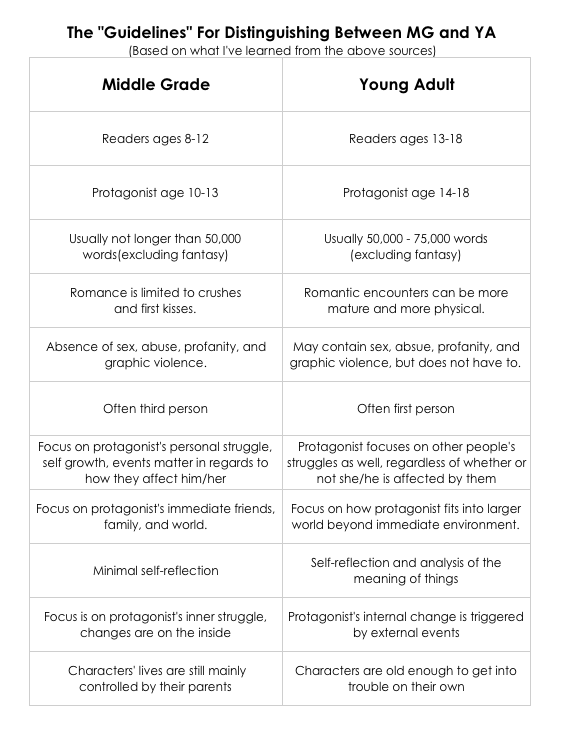
Almost every article or blog post mentioned exceptions to these rules, books like What Jamie Saw by Carolyn Coman, in which the protagonist is only nine years old, but the seriousness of the content bumps the maturity level up to readers over ten, and the Harry Potter series, which began with a 77,000-word MG fantasy and ended with a 200,000-word (!) YA novel.
Reading about these gray areas and many exceptions might have made me feel better about not finding a clear cut label for my novel draft, except that Lamba’s Writer’s Digest article begins with the admonishment, “A book that doesn’t fit into the parameters of either category is a book you won’t be able to sell.” Gulp. With those words, I found myself once again wanting my novel to conform, conform, CONFORM to one side or the other.
Then I discovered I Kill the Mockingbird.
I’ve already told you how much I enjoyed this book. So what is it? Young adult? Or middle grade? Well…
- At Barnes & Noble, I found it in the “Teen” section, so I thought it was YA.
- I looked up Paul Acampora’s website and found out it is labeled MG.
- The characters’ ages are never explicitly mentioned, but they just finished 8th grade. If they were here in Texas, that would make them 14, but they are in Connecticut, which (I think) would probably make them 13. (See? Even geography is at play here!)
- The kids’ lives are still mainly governed by their parents, but they are able to get in quite a bit of trouble on their own using bus passes and the internet.
- The first-person POV protagonist is dealing with first crushes (MG) and cancer survival (cancer is usually YA, but cancer survival, which is happy, can be MG) and is growing internally but is also learning how her actions can impact the whole world. However, she rarely engages in self-reflection.
- As far as readership? Hmm… I know it appeals to former teachers in their late thirties… I’m not sure what the readership would be. I would say it is MG (age 8-12) except for all the allusions to classic literature. This book revolves around To Kill a Mockingbird and makes references to Dickens, Twain, Holden Caulfield, Fahrenheit 451, and Norse Mythology, as well as people like Wil Wheaton, Chuck Wendig, and Cory Doctorow. (Not exactly sex, drugs, and rock-and-roll, but still topics probably unfamiliar to most eight-year-olds.) Then again, the book also references The Lorax and Charlotte’s Web and the Grinch.
Based on my observations, here is how I Kill the Mockingbird would place on our chart:
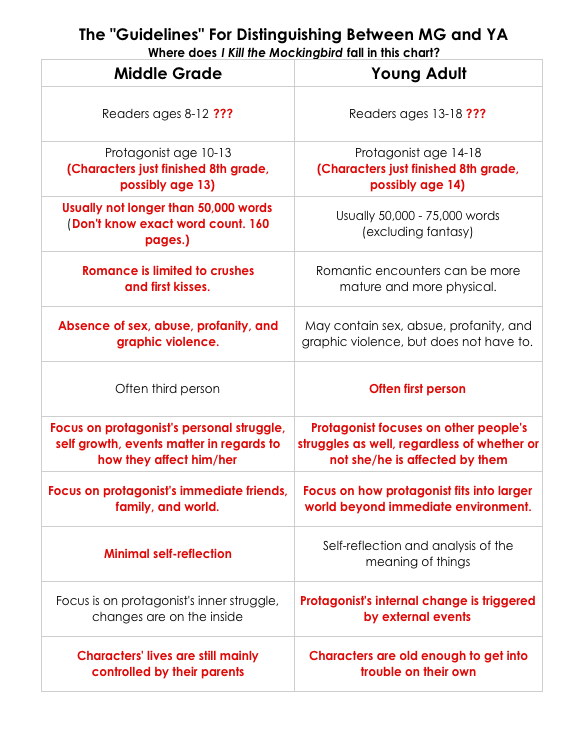
Not so easily defined is it? But it is a great book, and I think (hope?) in the end maybe that’s all that matters. Laura Backes ends her blog post with the words, “As an author, it’s your job to decide who you want to reach with your book… and then create characters and conflicts accordingly. Regardless of genre… if your characters are learning about themselves and the world in the same way as your readers, your audience will find you.”
When I place my own novel draft in the chart above, it still walks that center line in a lot of areas, but it leans to the right, to YA. Later, during revisions, I may have to tame it more to one side or the other, coax some of the gray areas back into semi-straight black lines, but for now my goal is to write a great book. That’s my top priority– the labeling can come later. If I’m able to do what I hope to accomplish, my novel will find its target audience (and maybe appeal to those former teachers in their late thirties as well). Right now, I’m going to trust my instincts and keep writing.