10 Writing Tips in 5 Days: Day 4 – The Reluctant Reviser

Your story, poem, novel chapter, or query letter is not good enough. You know this either because it’s been rejected three times or because a critique group gave you negative feedback, or because you just know, in your gut. Even so, you’re having trouble finding the motivation to revise. These are your words, and you liked them when you wrote them. You like them still, even though they’re not getting the job done. So you sit and you stare and you move commas around and replace adjectives with synonyms of those adjectives and you eat some chocolate. You, friend, are a reluctant reviser.

Revising is a vital part of the writing process, and getting over the reluctance to revise is an integral first step. If you find yourself stuck in the “it’s fine the way it is” swamp, try one of these tips to get yourself, and your writing, moving again.

My poem "Wildflower Season" after a revision workshop with Cindy Huyser at this year's AIPF
My poem “Wildflower Season” after a revision workshop with Cindy Huyser at this year’s AIPF

Tip #7: Clone Your Darlings

I always find it difficult to cut parts of a story or poem. I know I’m supposed to “kill my darlings” but what if I kill the wrong ones? What if I take something out that should have been left in? In short, what if I revise wrong?

The answer to this conundrum is so simple it’s stupid, and I’m embarrassed at how long it took me to think of it. Just make a copy first.

Before you kill your darlings, clone them. That way, if anything goes horribly, horribly wrong, you can go back to the original and start over. Now, whenever I start revising a short story that has been deemed “too long” or “too wordy” or “could be tightened up a bit,” I first create a duplicate of the file, labeling the two identical documents story_original and story_revised. Then I go to town chopping and cutting and pulverizing the revised copy, safe in the knowledge that those poor words I’m deleting still exist elsewhere. When I’m finished, I compare the results with the original, and you know what? I almost always like the new, concise version better. (And it usually irks me a little bit.)

Even after you cut sentences that you loved and accept the truth of their inadequacy, you may still have trouble sending that original file to the trash. That’s okay. You can be a file hoarder for awhile. It’s not like you’ve got a living room full of old Reader’s Digests and headless Barbies. (Right?) No one can see your Dropbox account. No one has to know.

I like to collect all of the deleted sentences and paragraphs with which I cannot bear to part in a single file. I call it Prose Purgatory. There the work sits, waiting in limbo, until I can finally accept that it is unnecessary and must be destroyed. This, however, is a rather cruel system. I urge you make the revisions as quickly and humanely as possible.

If I had taken the time to revise, I would have noticed that my phone changed the word "raccoons" into "tacos" BEFORE I posted this status update to Facebook. Oops.
If I had taken the time to revise, I would have noticed that my phone changed the word “raccoons” into “tacos” BEFORE I posted this status update to Facebook. Oops.

Tip #8: Listen to Yourself

When staring at your writing isn’t producing any epiphanies, try listening to it.

If you haven’t already discovered the benefits of this trick, you should. It’s amazing how many issues appear, as if by magic, when you read your work aloud. Silly typos that your eyes skipped right over suddenly grab your attention when you slow down and speak the words. Problems with pacing reveal themselves. Accidental repetitions practically glow on the page when moments before they did an expert job of hiding. Honestly, this is a strategy that can’t accurately be described. You just have to try it to see how well it works.

[Note: It was not until I read the previous paragraph aloud that I noticed I’d used the word “amazing” twice. I deleted the second one without giving it even a moment in Prose Purgatory.]

This was one of my favorite tricks to teach my seventh graders. Since there were twenty to thirty of them in a class, I had them put on headphones or cover their ears with their hands to drown out the other voices and feel less self-conscious. Plenty of them had assured me they were “done” and were skeptical about finding any more errors in their drafts. It was hilarious listening to a room full of kids all reading their personal narratives aloud at the same time, but it was even funnier watching one of the nonbelievers take a hand away from an ear to make an edit before catching my eye and blushing. I know this isn’t a very attractive thing to admit, but I love being right.

If reading your drafts aloud is already part of your writing routine, then try this: When you’ve found all the typos and repetition errors and you feel (again) your chapter or story is the best it can be, record yourself reading it. Then burn it to a CD or put it on your iPod and listen to it while you’re driving around or jogging or waiting in line at the pharmacy. (Yes, this means you will be literally listening to yourself talk. It’s okay. No one will know. Just don’t forget to turn the volume down before you order a coffee at the drive-through.)

This process is for ferreting out the more subtle issues with your piece. Where did you get bored, zone out and have to rewind? Where did you laugh out loud? Where did you notice a place that needed a bigger punch or more specific description?

The only danger here (besides a strong case of narcissism) is that you might be constantly pulling your car to the side of the road to take notes. Try not to cause any accidents. Remember that this is recorded. You can play it again, as many times as you want. Also remember that if you die in a car accident, then everyone will know the last thing you were listening to was the sound of your own voice.

Fresh carrots


Tip #9: Nothing Sounds Like a Carrot Except a Carrot

Mel Blanc, the voice of Bugs Bunny, spit out the carrots he chewed during recordings. This led to the rumor that Blanc was allergic to carrots or hated their taste, but that wasn’t the case. He simply couldn’t deliver his lines with a mouthful of carrot. So why not use something else to make the sound effect of Bugs’s chewing?

According to the article “Did Mel Blanc Hate Carrots?” from Straight Dope, there was simply no other substitute. The author writes:

The sound of Bugs chomping on a carrot while delivering a wisecrack was a key element from the beginning, but a technical problem soon became apparent: after taking a noisy bite of carrot, Blanc would have to chew for a while before he could swallow enough of it to deliver his next line. Other crunchy but more easily chewed foods (apples, celery) were tried, but the resulting sounds were deemed insufficiently carrotlike. The simplest and best solution, it turned out, was for Blanc to briefly chew on an actual carrot, then spit it out and go on with the voiceover. Ultimately a spittoon became a fixture in Mel’s recording-studio setup. 

“Insufficiently carrotlike.” I love that.

Sometimes what’s wrong with your piece of writing can’t be found on a word level or sentence level or even paragraph level. Sometimes the writing itself is fine, but the story lacks authenticity. The reader can tell you got lazy and used an apple instead of a carrot.

I used to hate the word research. Somewhere during my school years, it became synonymous with tiny handwriting on note cards that kept getting out of order and mind-numbing encyclopedia text and bibliography pages. Only recently have I figured out that research is just learning about stuff, investigating, becoming one with a topic. And it can be fun.

Since the main character of my YA novel is an eighth grade gamer, I get to count the following things as research:

  • Reading books like Extra Lives by Tom Bissell and All Your Base Are Belong to Us by Harold Goldberg
  • Playing hours of Galaga and Ms. Pac-Man at the arcade
  • Standing behind my husband while he’s gaming, asking him questions like: “What’s that thing for? Why did you decide to change your armor? What would happen if you jumped off that cliff? How come you’re not killing those guys? Are you dead now? What will you do differently next time?” (This counts as research AND quality family time.)

Not all research is fun though. I got a pretty massive headache after trying to decipher the language of the World of Warcraft message boards. But I did it, and if need be I’ll do it again. (*shudder*)

The point is that you can’t fake it or your reader will know. You have to spend the time and do the homework to get it right. If that means reading books on archaeology, or shadowing a Home Depot employee for a day, or hanging out in an arcade for an afternoon writing down the things people say when they see the words GAME OVER on the screen, then do it. Sadly, not all story issues can be solved just by cutting and pasting or listening to yourself talk.

Sometimes you have to chew the carrot and spit it out. Like it or not.

For more revising tips, check out these posts from two of my favorite blogs:

[Stay tuned for the LAST tip tomorrow! And if you still need to catch up on Tips #1-6, click here to go back to the start!]

10 Writing Tips in 5 Days: Day 3 – Get Yourselves Organized!

The title of today’s post comes from one of my favorite moments in…

CloseShave

[If you haven’t seen it, do yourself a favor and watch this two-minute clip on YouTube. If you like stop motion animation or motorcycle sidecar humor or sheep, you won’t be disappointed.]

To be writers, we must be creative, imaginative, artistic, and open to the clutter and chaos of our minds. However, to be successful writers, we must also be organized.

Fortunately, organization is one of my strong suits. Keeping things in order has served me well in my teaching life, my home life, and my writing life. So, if your creative process is starting to resemble a messy sock drawer (*shudder*) or a kitchen pantry with absolutely no thoughtful purposing of the shelf space (*double shudder*) or the master closet in my husband’s house before I moved in (*oh the horror!*) then I hope these tips can help you reign in the madness just a little bit.

GetOrganized

Tip #5: Set Up a System

Some people simply want to write “when the mood strikes.” They think structuring their writing time into a schedule will take away the passion of their art and mess with their muse. That format works so long as things are going well and the words are flowing, but eventually your muse is going to call in sick or skip down to visit her mom in Florida or read a book about organic gardening and suddenly decide THAT’S what she wants to do with her life. (Muses are fickle little creatures.) If you want writing to be more than just a hobby, then you’re going to have to produce work even when your muse is babbling on about soil pH to the woman giving her a pedicure in Tampa.

On the flip side, a lot of authors say that you should have a regular routine where you write at the same time every day. (I can’t say those words without picturing a drill sergeant with a scowl.) It’s a great idea, and I’ve tried to make it work, but I just can’t. Too many other variables get in the way. Some mornings I have yoga. Some afternoons I attend Meet-Ups. Some weekends I have book club. Some nights my husband and I eat popcorn with the dog and watch Game of Thrones. There are not four consecutive hours in every day of the week that are free to write, and none of those other activities are negotiable. Each one (exercise, networking, talking about books, relaxing family time) are all integral to me being a happy, healthy writer.

So instead of a daily routine, I set up a weekly one. I keep my weekly schedule on a bulletin board by my desk. The items are made up of color-coded sticky tabs, which make it easy for me to switch things up. I redo my schedule about every two months because… A) Life obligations and class schedules change. (When the weather gets hot, I like to swim, so my routine is affected by pool hours.) And B) It’s just nice to mix things up. I’m great about following plans and schedules until they become old hat. Then I need something new to get me going again. Changing things up every few weeks gives me new energy and motivation.

Rather than show you my whole weekly schedule (I like you people, but I don’t exactly want you to know where I am every second of every day) I’ll just give you a couple of the writing-related highlights.

  • Sundays = Goal-setting. I come up with three or four specific, high-priority, achievable goals for the week. I post them in my office and email them to my critique group friends so they can help keep me on task.
  • Thursdays = Get out of the house. I meet a friend at a coffee shop to work. We generally stay from about 10:00 to 2:00. Since that’s a long time for me to focus on one task, I come prepared with more than one item on my to-do list. I might finish a chapter or draft a blog post, then move on to critiquing a colleague’s work or reading a Writer’s Digest article.
  • Fridays = Save & Assess. Every Friday, I back up all of my files. (I use Dropbox to do this, but there are other options too.) I used to be really bad about remembering to back up my work, but now that it’s “on the schedule” it gets done. Then I look back at my weekly goals and assess my progress. If I’m almost done, I get to finish up and spend the afternoon doing something fun. If not, it’s back to work. (Note: It’s usually back to work.)

This schedule is not set in stone. (As I mentioned before, it’s in sticky tab form.) While it gives me a solid framework for my week, it still leaves plenty of wiggle room for when my muse waltzes back in the door like nothing’s happened and plops herself down in my desk chair with a smile.

Every writer’s system is going to look different. Your schedule may be limited by a full time job or kids or both, but you should try to get the most out of however much (or however little) time you have to write.

If nothing else, set aside a time each week to ask yourself the following questions:

  • What are my goals?
  • Which goal is my top priority?
  • What’s my deadline for accomplishing this goal?
  • What’s the first step to meeting that deadline?
  • How long has it been since I backed up my work?

The time it takes to answer these five questions will be time well spent. Then you can build the rest of your writing week from there.

Tip #6: Document Thyself

Setting up a daily or weekly schedule is about the BIG picture: setting goals, making time to write, getting things done. If you do it right, you’ll soon be doing just that—producing. And once you start producing, you’ll start submitting your work to the world.


FlyingMonkeys
“Fly, my pretties, fly!” (Okay, I totally just creeped myself out with this image, which I borrowed from http://english421atlouisville.wordpress.com/2011/10/31/8-myths-about-the-wizard-of-oz-some-of-which-are-true/.)

Next comes the nitty-gritty side of staying organized. You have to keep track of what you submit and where and to whom. How will you know if it’s time to start biting your fingernails over those contest results if you don’t know when the contest ends? How embarrassing would it be to accidentally send the same poem to a journal twice because you forgot they already read it (and rejected it) before? Keeping a log of all your submissions will help avoid these blunders.

I use Excel files. I create one for each year of submissions, then I have a separate file for all of my published work and awards.

Here’s a sample of what my submission tracker looks like. All of the information on this one is fake, but you probably figured that out already.

Sample_Submissions_Tracker

Note: SS stands for simultaneous submission. Some publishers don’t mind, but most of them want an exclusive look at your stories and poems.

Here’s a downloadable copy. Feel free to use this format to make your own.

Carie_Juettner_Sample_Submission_Tracker

Here’s how I format my publications and awards file. This information is real, but not complete. To see more of my published work, click here.

Publications_And_Awards

Note: It’s nice to have all of this information in one place when I am writing a bio or acknowledging the original publication of a piece I’m submitting to an anthology.

The first time I went to Annie Neugebauer’s website and clicked on The Organized Writer, I knew I’d found an organizational soul mate. She has a nifty little document for everything. No way are there any messy sock drawers or embarrassing junk closets in this woman’s home. No. Way. I suggest you spend some time perusing her offerings. She’s done all the hard parts for you!

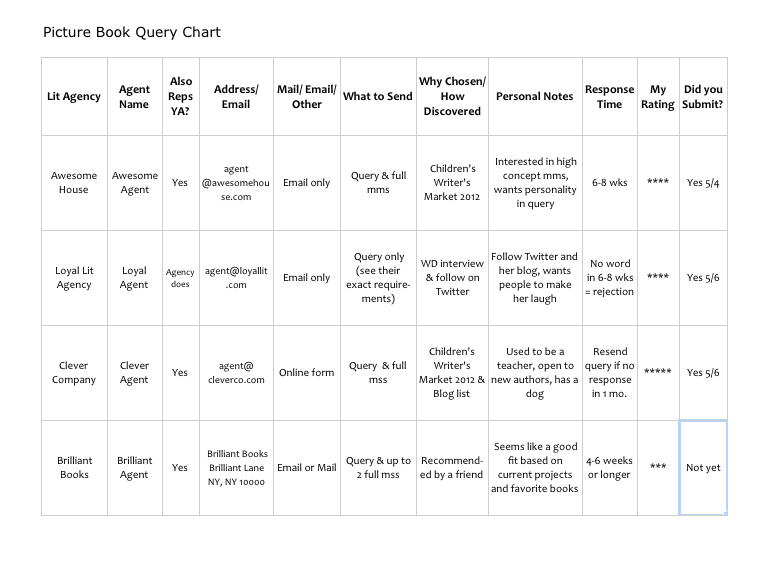
Recently I decided it was time to seek an agent for my picture books. (You didn’t know I also write picture books? I do! I’m currently seeking representation for The Evolution of a Bark, where a simple dog bark evolves into a hilarious scene that’s entertaining for young readers and educational for middle grade students.) This being a new endeavor for me, I needed some guidance, so I modified Annie’s Agent Query Prep-work Chart into my own tool. Here’s a sample of mine (with some creative editing to protect identities).

Sample Query Chart


Note: MSS stands for manuscript. You may notice that most agents requested the full manuscript of my book. That is only because it’s a picture book. When it comes to novels, most agents want either a query only or a query and the first ten pages. Then again, some ask for three chapters and others only want a synopsis. That’s why these files are so important. It’s a lot of information to keep up with.

Staying organized is a job in itself, and it can be a difficult one at first, but once you get your system up and running and your files in order, the benefits are apparent and the maintenance doesn’t take up much time. And it’s not like you have to always be tidy. Anne Lamott says, “Clutter is wonderfully fertile ground.” Once in a while, it’s okay to lose yourself in a glorious mess.

[Did you miss Tips #1-4? Click here to start from the beginning!]

10 Writing Tips in 5 Days: Day 2 – Join the Club

AIPF

Tip #3: Build Your Own Support Group

Historically, writing is said to be a lonely business. We’re all supposed to be depressed, nocturnal addicts angrily slaving away at our typewriters and dying early deaths. Or something like that. Except for the nocturnal part, it all sounds like a giant drag to me.

In my opinion, these days if you’re a lonely writer it’s because you’re choosing to be lonely, because the thing is, you’re not alone. At all. The reason why it’s so hard to get published is because there are SO MANY OF US out there trying to get published! Writers are not scarce. They’re not rare. They’re not exclusive. They’re not unique. Recently on a train, I asked a stranger what he did for a living. He told me he was a patent lawyer. I nodded and smiled, thinking, That sounds boring. Then he asked what I do, and I smiled even bigger and told him I was a writer. He said, “Oh yeah? I wrote a novel a few years ago. It never got published.”

WE. ARE. EVERYWHERE.

Wait! Wait. Don’t go jump off a bridge. Instead, embrace it! We are living in the age of connectivity, so connect! Find other writers and talk to them! Hang out with them! Write with them! Yes, building your own little writing community will destroy that image of yourself as a unique little writer snowflake, BUT it also makes the writing life less lonely and opens the door to all sorts of new opportunities for learning and growing in your craft.

Where to start? Well, there’s… social media, critique groups, blogs, organizations, discussion boards, meet-ups, hang-outs, play-dates, and stalking industry professionals in coffee shops. Wait, don’t do that last one.

There are so many opportunities to connect with other writers that it’s kind of overwhelming. Instead of trying to give you an overview of all the options, I’ll just tell you what my personal writing community looks like. My support groups include: two meet-ups that I attend regularly, membership in three writing organizations, participation in social media, and writer friends who I communicate with either in person or via email on a regular basis.

MyWritingCommunity
(For some reason, I thought a colorful web would be the best way to display my writing community. Now that I’m finished I’m not so sure anymore.)

Know that this web didn’t happen overnight. It’s the result of two years of venturing out of my writing cave and sending threads out into the world. Just like in Tip #1, I suggest you start small and find the appropriate groups and level of participation for your current situation.

 Tip #4: Go to a Festival or Conference… TWICE

I remember the first time I rode the Texas Giant roller coaster (back when it was still wooden) at Arlington’s Six Flags Over Texas when I was in middle school. The wait must have been at least forty-five minutes long, plenty of time to chew off all ten of my fingernails, consider chickening out a half a dozen times, and ask my friends just exactly how scary it was about, oh, every fifteen seconds. I remember how terrified I felt on that slow click, click, click ascent to the top of the first enormous drop. I remember worrying I might cry or pee myself or fall out and die (the last of which actually happened to a woman last July—I encourage you NOT to read the horrific details if you want to continue riding roller coasters). I remember my terror quickly transforming into terror-ific thrill as I made it down that first hill and experienced the rest of the fast falls, stomach-lurching turns, and bone-rattling excitement that the Giant had to offer. I remember exiting the car—legs shaking, stupid grin plastered to my face, friends bouncing circles around me—and doing what every middle schooler does after their first big roller coaster ride. Get back in line. The next forty-five minute wait was completely different. As my stomach both settled down and churned with anticipation, I stood proudly, knowingly, and when the youngsters behind me bit their fingernails down to nubs and asked their dad, “Does it go really fast?” I chuckled and rolled my eyes and thought, Amateurs.

Who doesn't love PhotoBooth?
Who doesn’t love PhotoBooth?

Joining the writing clubs and organizations available to you is only the first step. Next you actually have to participate. Read the newsletters, go to the meetings, attend the workshops and conferences. You’re not in high school anymore. (Unless you are, in which case, go do your homework.) This isn’t like joining the Honor Society just so it will look good on your college applications. If you’re going to be a part of something, then be a part of it. Get involved. (Wow, I’m suddenly sounding a lot like the mom in my middle grade novel.)

The first time you attend a conference or festival, you get to know interesting people, learn more about the topics presented, and come home with journals full of notes, new friends, ideas, and to do lists, all of which you can’t wait to start reading, contacting, drafting, and implementing.

But, as inspiring as conferences and festivals can be, they can also be confusing, humbling experiences. You don’t know where to park. You go to the wrong room. You realize you were supposed to bring a draft to work on (which you didn’t) or you notice that yours is the only laptop in a room full of moleskin notebooks and fountain pens. You nod and smile and ask “Who?” a lot. People around you hug and inquire about each other’s lives, calling children and novels drafts by first name. They say things like, “This is a nice space,” and, “Well it couldn’t really get worse than last year!” Everyone laughs and you nod and smile.

More than once during my first festival appearance, I thought to myself, Why don’t they make this easier on new attendees? And, Yes, yes, you’re best friends, I get that, but could someone just tell me where the closest coffee pot is? And, I am NEVER going to act so cliquish at a conference, EVER!

Still, the benefits far outweighed the annoyances, so the next year, I went back.

I parked my car in the free garage, knowing that they never check stickers on Saturdays. I interrupted my advice to a newbie about how to sign up for poetry readings to squeal and hug a friend I hadn’t seen in a while. And, when someone commented that the sound system made it a little difficult to hear, I caught the eye of a festival veteran like myself and burst into laughter, thinking of the rattling air conditioner that drowned out half the speakers in the venue the previous year. Then I noticed the blank look on the newbie’s face, stopped myself, and blushed.

I didn’t mean to make anyone feel left out. My actions weren’t malicious at all. I was just comfortable, confident in my surroundings and at ease about how the event would progress. I had a good time the first year, but the next year, I was in my element. That’s how it feels when you’re in the club.

So don’t be afraid to attend festivals and events. And if things don’t flow as smoothly as you’d hoped, don’t be afraid to go back. The second time you’ll be able to anticipate all the drops and turns and sharp corners, and it will be an even more enjoyable ride.

Advice for Event Attendees:

  • Get as much info as you can about the location and schedule beforehand. If possible, ask someone who has attended the event what to expect.
  • Don’t be afraid to ask questions. Start by saying, “This is my first festival” or “I’m new here” and people will be nice to you.
  • When in Rome… follow the social parameters of the event. If several other people are taking notes on laptops, go for it! If not, don’t be the only laptop geek. Come prepared with various materials so you can adapt to any environment, regardless of internet access, wall outlets, or available seats.
  • Find other newbies and band together. Safety in numbers!

Advice for Event Organizers:

  • Provide a detailed FAQ page on your website.
  • On maps and schedules, avoid phrases like “same place as last year” and “the usual parking area.”
  • Ask someone who has never attended the event to look over the website/information and provide feedback on omissions and areas of confusion.
  • At the end of the event, ask for feedback from attendees about improvements that could be made for the future.

[Note: This June, I’ll be attending the Writers’ League of Texas Agents and Editors Conference for the first time. If you have attended and have any advice for me, please leave a note in the comments or send me an email at cariejuettner@gmail.com!]

Bonus Links:

[Did you miss Tips 1 & 2? Catch up here!]