Review: Smallest Leaf

To be honest, I rarely read poetry collections cover to cover. I enjoy too much the freedom of opening a poetry book to any page and receiving a slice of meaning. When I do follow the “rules” and read the poems consecutively, it often takes me a long time to make it to the end. I revel in the ability to close the book for long periods of time and not feel like I have to start over when I pick it up again.

But once in a while, a poetry book grabs me in a different way and makes me sit down and dig in. Smallest Leaf by Lisa Toth Salinas did just that. I opened it to page one last Monday morning and finished it before I went to bed that night. And it was a delight.
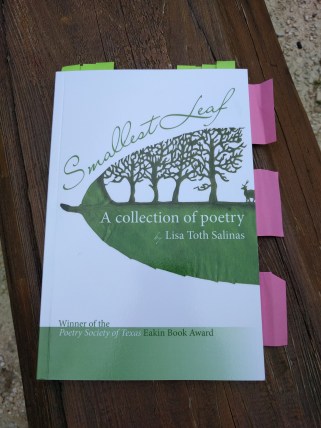
IMG_20160416_121447
My copy of Smallest Leaf, bookmarked with love.

I learned about Lisa’s book when I met her in November at the Poetry Society of Texas’s Annual Awards Banquet. Lisa lives in Texas, and Smallest Leaf, which is her first collection, won the Poetry Society of Texas Eakin Book Award in 2014. It is a gorgeous volume, both inside and out, including images of art (used as the inspiration for some of her ekphrastic poetry) and found poems.

I knew I was going to love this book from the very first piece, titled “How to Read a Poem.” It begins:

“Make yourself the smallest leaf
upon the tree and let the breeze
of gentle words begin to blow,
then loosen from your branch. Let go.”

I followed the poet’s advice. I let her gentle words wash over me and gave in to her voice. Lisa’s work covers topics close to her heart—art, ancestry, faith, family, nature. Some of my favorites were: “She is Not the State Bird of Texas,” “On Solitude,” “A Lesson in Trust at the Feet of Millet,” and “Inheritance.” They spoke to me with their simplicity, their thoughtfulness, their hope. Even the poems that didn’t resonate with me personally are full of the poet’s passion for the subject. I liked all of her work for that, for endearing me to her perspective on life.

However, what I enjoyed most about Smallest Leaf was the variety of interesting forms within its pages. Lisa writes free verse, rhyming poems, found poems, sonnets, and villanelles, but her work also includes less common forms such as pantoum, haibun, terzanelle, and gloss, which is a type of poetry I was not familiar with but am now eager to try.

I will end with a stanza from her poem, “Advice to a Poet,” which is a garland cinquain.

“Poet,
to beautify
an empty page you must
hear what is not being said, then
say it.”

My advice to you is to read Lisa Toth Salina’s book, Smallest Leaf. You can order a copy and find out more about her and her work on her website.


Guest Post, Horror, YA, & The Mysterious Disappearance of March


March is almost over, which is just weird. Where did it go? No, I mean, seriously, where did March go? I feel like I blinked and missed it. But then I look at my to-do lists and my all-done lists and I realize that a lot of it went where months always go—into books and poems and computer screens and dog walks and libraries and schools and, sometimes, into the very bottom of bags of Milano Double Chocolate cookies. And that’s okay.

I wanted to post here one more time before March waves its final goodbye, to catch you up on some things you might have missed and some things that are happening now and some things to look forward to in the future.

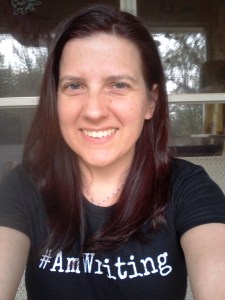
First and foremost… this is my new favorite t-shirt.

Am_Writing


Awesome, right? I think so too. Ok, moving on.

Guest Post News

A couple of weeks ago, I wrote a guest post called “Tuning in to Good Writing” for the WOW! Women on Writing blog. If you missed it, you should check it out here. Feel free to leave a comment on their site about what kind of music you listen to when you write.

Horror News

My short story “The Other House” is out now in the latest issue of Under the Bed. You can download it here it for just $3.99. And if you buy it by Friday, April 1, 2016, you can enter the coupon code SPRINGSALE to get 50% off. $2.00 for five stories is a pretty good deal. My story was inspired by my friend’s three-year-old daughter and her vivid imagination. I hope you enjoy it!

UndertheBedVol04No06

YA News

Lastly, I am SO excited to announce that my short story “Teardrops and Watermelon Seeds” has been accepted for publication in Ember: A Journal of Luminous Things and Spark: A Creative Anthology. Writers, like parents, probably aren’t supposed to have favorites among their literary children, but this coming of age YA story with magical realism holds a special place in my heart, and I’m thrilled that it’s found a home in these beautiful publications. I don’t yet know which issues will include my work, but I promise to keep you posted.

EmberAndSpark

Well, that’s it. Now March can blow on out of here and April can have its turn. Let’s all agree to slow down a bit and enjoy it, shall we?

Review: The Girl in the Well is Me

The Girl in the Well Is Me

The Girl in the Well is Me by Karen Rivers

Summary: Eleven-year-old Kammie is stuck in a well, and the only people who know she’s in there– three mean girls from school– may or may not be going for help. As Kammie slips further and further down the shaft, feeling every scrape on her raw skin and drifting in and out of hallucinations, she thinks back on the last few tumultuous months of her life, allowing the reader to piece together, bit by bit, who the girl in the well really is.

On the cover of The Girl in the Well is Me is a quote from Katherine Applegate that says, “I dare you to pick up this riveting novel without reading straight through to the heart-stopping conclusion.” When I saw that, I scoffed. I hate it when people tell me they read a book in one sitting because I almost never do, no matter how short it is, and I certainly didn’t believe Ms. Applegate about this 200-page middle grade novel. But I had to eat my words this time, because she was right. I read this book straight through, only stopping once to eat dinner. And even then, I felt guilty for leaving poor Kammie in the well while I sat on the couch eating pasta.

What I loved about the book:

* It’s a fast, riveting read, especially for a novel with so little dialogue.
* Writers are told to let bad things happen to our characters, and Karen Rivers really takes this to heart. It’s possible to argue that getting stuck in a well is not the worst thing that has happened to Kammie and even if it is, it’s the cherry on top of a large sundae of terrible things that have happened in her life recently. The book deals with some big bad issues, but it does so in a way that is appropriate for the intended audience.
* The way the back story is woven in is well-done (no pun intended). The revelations are surprising without feeling forced and continue to paint a more vivid picture of the character.
* Despite how much Kammie suffers, the book is also quite funny in places. She has a great voice and a few lines were hilarious enough to make me laugh out loud, like the part about the cats’ names on page 114, and this sentence from page 104: “It doesn’t get worse than being a Grandma-quoting well-bound girl in Texas with a crabby spider on your foot.”
* In her notes at the end of the book, the author makes reference to Baby Jessica, the eighteen-month-old who was stuck in a well in Midland, Texas, for more than two days in 1987. I also vividly remember following that story when I was in elementary school, which is another reason why this book appealed to me. I enjoyed reading from the point of view of the girl in the well, even though Kammie was much older than Baby Jessica.

Why not 5 stars?

First, I didn’t love the very end. It’s hard to explain why without giving anything away, so I’ll just say that I wish the book had ended a little sooner. Also, I really enjoyed reading this book in one sitting. It made it feel like I was there with Kammie, experiencing the trauma in real time. But there’s part of me that feels like you NEED to read the book that way to really enjoy it. I could see how repeatedly putting it down and picking it up again over the course of days would take away the immediacy of the situation. It might feel slower and more repetitive that way since, after all, this is a book that takes places almost solely in a well.

Overall, though, The Girl in the Well is Me is a great read that I think would appeal to lots of kids.