Ok, this is barely even counts as a post. It’s totally random. (So random, in fact, that I had to create a new category called “Random” because: A) This does not fit into any of my other categories and B) I predict more future randomness.) It’s also more of a tease than anything.
Today, while having lunch at the Whole Foods near my house, I noticed this:
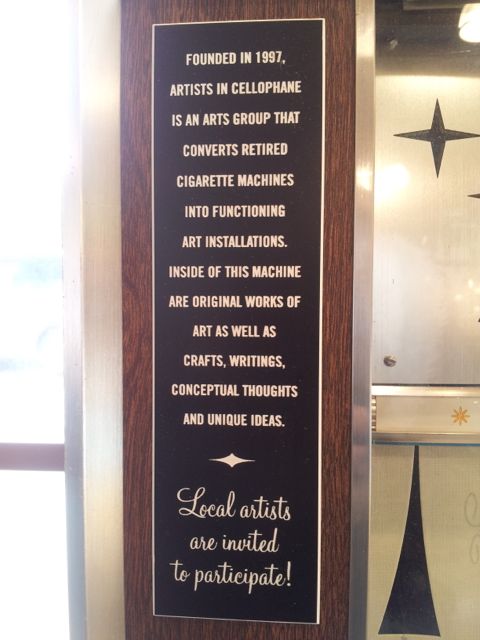
At first I thought it was a cigarette machine, but that seemed highly unusual, since the last working cigarette machine I saw was in Germany, and I was currently surrounded by organic foods, signs telling me to live a healthy lifestyle, and so many different waste receptacles that I almost got a little confused throwing away my compost-able lunch container.
It was not a cigarette machine, it was an ART MACHINE. !!! Check this out:
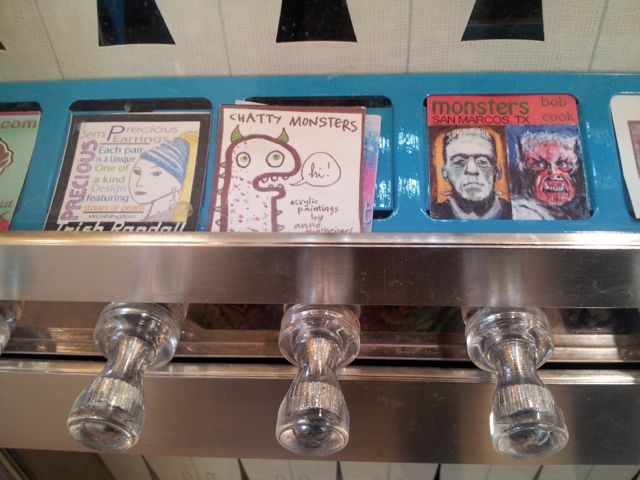
Pretty cool, huh? I couldn’t quite understand what was in there, but I knew I wanted it. I had no cash, so I bought a few things from the store, paid with my debit card, got some five dollar bills and went to work choosing my selection. It turns out it wasn’t that difficult. (Monsters! Duh.)
Here’s where the story gets disappointing. Whatever was in my cigarette-pack-shaped monster box got stuck in the machine. Ever an optimist, I put in another five dollars, hoping to unstick it and get a second one, but no. At that point nothing would work. I had, apparently, broken the art machine. 😦
The guys at Whole Foods were super nice and gave me my ten dollars back, but the man who “knows the machine” was not there, so they put a sad little “Out of Order” sign on it and I went about my day. But I will be back! I love this idea (despite the fact that it didn’t work for me today) and I can’t wait to find out what treasures await inside.
Has anyone else seen these anywhere? Has anyone successfully bought something from one? If so, please share!
Today, while I was trapped inside by the quarter inch of ice that shut down Austin, Texas, I attempted to weed-out my picture book collection. I was not successful. Rather than getting rid of a single book, I instead spent forty-five minutes re-reading favorites such as Miss Nelson is Missing and Harry the Dirty Dog and Frank Baber’s Mother Goose Nursery Rhymes that my parents gave me for Christmas when I was one.
“There was an old woman who lived in a shoe, She had so many children she didn’t know what to do…” Anyone remember how this nursery rhyme ends?
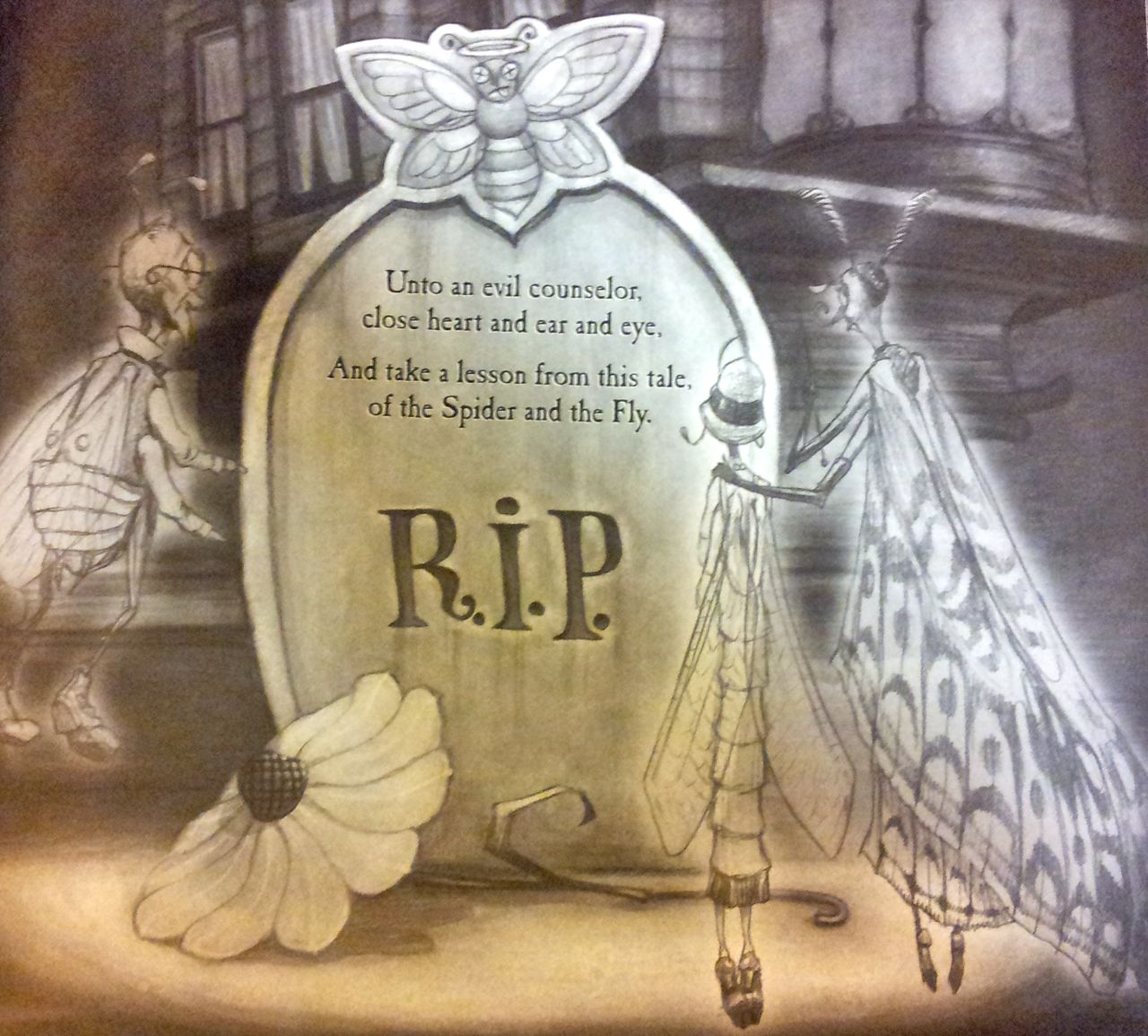
During my fruitless search for titles I could live without, I came across Tony DiTerlizzi’s beautifully illustrated version of Mary Howitt’s The Spider and the Fly, and it brought a grin to my face. This cautionary tale about a fly who is foolishly taken in by a spider’s flattery was one of my favorites to use in the classroom.
You may be thinking, Wait,I thought she taught middle school? I did. Children’s books are excellent teaching tools for students of all ages. They’re short, they’re great mentor texts for introducing new literary elements, and they’re crowd-pleasers. It’s amazing how quickly twelve-year-olds will gather on the floor for someone to read to them. Most of us never outgrow of the joy of “story time”.
Over the course of my teaching career, I read many picture books to my classes. I used Jane Yolen’s Greyling to teach plot development, Denise Gruska’s The Only Boy in Ballet Class to teach theme, and Nick Bruel’s Bad Kitty for word choice. We read Chris Van Allsburg’s The Mysteries of Harris Burdick to brainstorm short story ideas and Scieszka and Smith’s The Stinky Cheese Man just for the fun of it. But The Spider and the Fly was always one of my favorites.
As a literary reference, the book has lots of merit—it can be used to demonstrate anything from theme to mood to rhyme scheme to how to punctuate dialogue. But for me, the real reason for reading it came after the lesson was over, when I had the pleasure of having the following conversation with my students.
It goes something like this:
We finish discussing the literary elements of the story, and I tell my students that my favorite thing about the book is that the fly dies at the end, which elicits the expected reaction. The students gasp, accuse me of being mean, and ask the big question. “Why?” I tell them it’s because the story hasn’t been messed with yet.
“Messed with?” they ask. “What do you mean?”
Then, I ask my students to tell me the story of the three little pigs. Without exception, every class tells me the version where the pig who builds his house out of straw runs to his brother’s house when his own is blown down by the wolf, and then both of them run to the third pig’s house when the one made of sticks is blown down too. There, saved by the sturdy brick house, they all survive.
“Wrong,” I tell them.
Wrong?
“The first two pigs get eaten by the wolf.”
What?! The thirteen-year-olds in front of me are shocked. They honestly don’t know this version of the story. When asked why it was changed, I shrug. “Too violent, too upsetting for little kids.” They seem to understand this—some of them look pretty unsettled themselves. They don’t see any problem with the revision. So I probe further.
“In your version of the story,” I say, “the moral seems to be that if you’re foolish and lazy, someone smart and hardworking will save you. What do you think is the moral of the original version?”
They think for a moment until someone says, “Um, if you’re foolish and lazy… you die?”
I shrug, and they get a little nervous.
They ask me what other stories have been changed and I tell them about the evil stepsisters cutting off their toes to try to fit the glass slipper in Cinderella. This also produces the desired effect.
“So,” I say, “back to The Spider and the Fly. Right now the story is still unchanged. It’s a cautionary tale about the dire consequences of giving in to false praise and dangerous temptations. What would happen if someone decided the story was too harsh for children?”
The answers come in bursts, pieces.
“She wouldn’t die.”
“He wouldn’t eat her.”
“The spider would learn a lesson.”
I am nodding, but obviously waiting for more. Then, inevitably, one kids gets it.
“They would become friends!”
I smile. Yes.
One year, a student with eyes wide open in astonishment, said, “She wouldn’t die. The spider would learn his lesson. Then they would learn to appreciate their differences, and they’d become friends and eat pancakes together!”
Exactly. Well, I’m not sure about the pancakes part, but otherwise, yes, you got it. It’s only a matter of time until this tale too is softened, its true lesson buried beneath our fear of scaring children.
At that point, if I had paced my lesson appropriately, there would be just enough time left before the bell for the class to ponder this new revelation. Their stories had been changed. In the real world, flies died, pigs were eaten, and greed could lead a person to chopping off her own feet. These kids were seventh graders. It was time they knew.
These are the conversations I loved when I was a teacher, the moments of epiphany I miss. The lessons not covered in the curriculum were always my favorites.
I keep my copy of The Spider and the Fly as a reminder, a cautionary tale.
[To read more stories from my teaching career, check out my Teaching Stories page.]
This week, my house has been acting like it’s October instead of January.
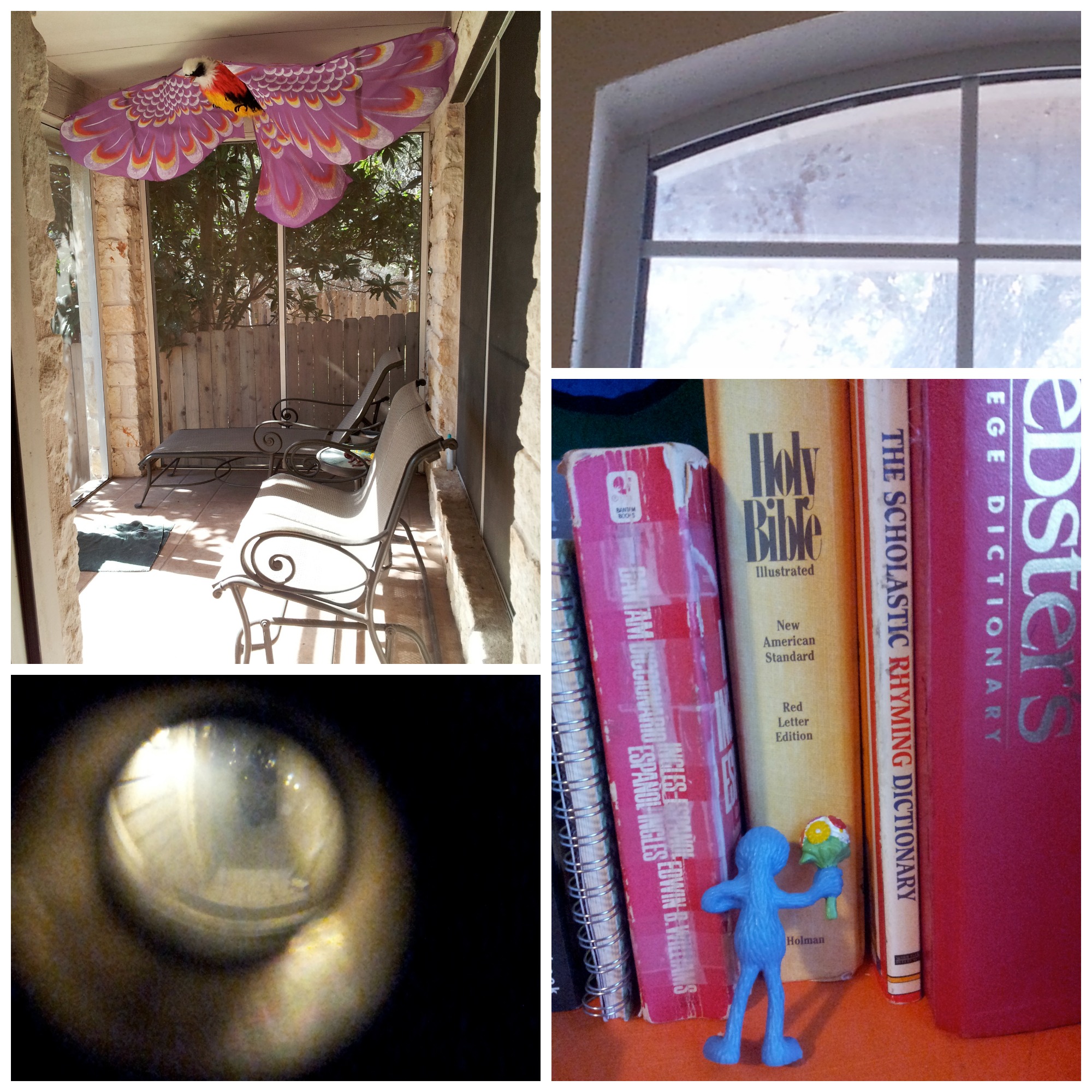
First, I noticed tiny hand prints in the high window above my front door. Raccoons, you say? My money’s on gnomes. Either way, something’s been peeking in my window. Next I inherited this beautiful* new bird from my good friend Emily and promptly began to have nightmares about it chasing me. The bird’s name is Windcleaver now. I’m hoping that naming her will squelch her tendencies toward evil. Then I gave myself a mild heart attack when I looked out my peephole and saw the shadowy figure of a man-beast on my porch. It turned out to be some sort of fiendish reflection of the brass knocker, but I’m still half-convinced one of the creatures from The Fog was standing on my doorstep. Yesterday the dinosaur toy with the dead batteries awoke and growled at me, eyes flashing, from my closet. (That was unsettling.) And today I noticed that my tiny Grover figurine, who usually smiles sweetly at me from his perch in front of my German dictionary, was instead leaning forlornly against my Bible. He has not told me why.
*Apparently Windcleaver’s beauty is subjective. My husband seems to be plotting her demise.
Do you see the torso of the man in the lower left photo? Please tell me you do. No, wait. Please tell me you don’t.
These “amusing” little instances of inanimate objects coming to life and sinister visitors showing up at my door remind me of my first published short story. It appeared in Issue 12 of Dark Moon Digest, which came out last July.
If you’re up for it, grab a cup of something warm, turn the lights down low, and spend a few minutes reading “The Jack-in-the-Box”. Oh, and make sure your closet is securely closed first.
* * * * * * * * *
THE JACK-IN-THE-BOX
Jenna turned the little metal crank with the plastic handle.
Do doop, do doop, do doop DOOP doop do, do doop, do doop, do doooo doop…
The tune of “Pop Goes the Weasel” lifted haltingly into the air. The notes were dissonant, each landing with a soft plunk as Jenna turned the crank as slowly as possible, trying to see how close she could get to releasing the clown doll inside without actually letting him out.
Do doop… do doop…
Her little heart pounded with excitement. She felt sure that if she could just stop at the right moment, maybe she could see–
Bam!
Jenna’s door banged open and she gasped, her fingers slipping from the handle. Her mother stood in the doorway, lips pursed, hands clenched into fists.
“Jenna, must you keep playing with that thing?” she growled.
Jenna looked down at the floor. “I like it.”
“You like it? Honey, you scream or shriek or gasp every time it pops up! How is that fun?” Her mother looked more frazzled than usual. Jenna noticed she had two more Band-aids on her arm.
“It just surprises me, that’s all.”
“Ha!” Her mother’s laugh made the little girl jump. “Surprises you? That is the most predictable toy in the world. You know exactly what is going to happen and exactly when it is going to happen. Every single time. And you have been playing it over and over again every night before bed for a whole week. How could that possibly still startle you?”
Jenna said nothing.
Her mother scratched at her neck with her right hand, leaving bright red streaks in the dry skin of her throat. Then she heaved a long sigh. “Let’s just get rid of it. Why don’t we?”
The ten-year-old girl looked her mother in the eye. “It was Dad’s,” she said in a soft voice.
Predictably, her mother stiffened. Her shoulders drew back and her chin jutted out sharply. She crossed her arms and cleared her throat. “Okay, fine. But that’s enough for tonight. Get to bed.”
“Okay, Mom. Let me just finish this one.” Jenna put her hand back on the handle and began to push. Then, glancing at her mother still in the doorway, she shifted slightly, turning the back of the box toward her mom.
Do doop… DOOP… doop do… POP!
Jenna and her mother both jumped slightly. She’d turned the crank too far. There he was––the clown doll. Just as expected.
Jenna finished out the last notes of the song and then carefully folded him back into the box and closed the lid with a click. “Goodnight, Momma,” she said and climbed into bed without offering her cheek to be kissed.
Her mother stood in the doorway another moment before leaving without a word.
In the dark, after her mother had gone, Jenna turned the old metal box over in her hands. The light was too dim now to see its images, but she knew them by heart after studying the thing for so many hours.
The box was colorful, or used to be, before the sun faded it during all those years it sat facing the window. The main color was blue. The lid was blue and the edges of all four sides. Within the blue, each side showed a different circus scene. On the back of the box, there was a red and white striped big top tent with a crowd of people in front, waiting to get inside. It was the least faded. On the left side was a ringmaster, wearing a top hat and tux, carrying a whip in his hand. On the right, there was a sideshow strong man, muscles bulging, holding a barbell high over his head. The front, which had faced the morning sun, was faded to pastels. It showed one car of a circus train with the heads of lions, elephants, and bears peeking up, smiling, over the top and through the windows. Jenna liked that side the best and wished it wasn’t so faded.
Inside the box was the clown. He gave a pretty powerful first impression when he made his appearance—all crazy hair and flailing arms, blue and yellow striped outfit and bright red smile––unfaded, hidden from the light, protected.
On closer inspection, he wasn’t very impressive at all. He had thin, cheap cloth for his clothes and a hard plastic head that was painted sloppily. His red mouth was not exactly where his mouth should be and part of the green of his hair smeared onto his forehead.
Jenna thought it was odd. The outside of the box was so pretty—or at least it had been—but the inside looked like it was slapped together without thought, without care. Maybe, she mused, you aren’t supposed to look at that part closely. Maybe you are supposed to scream and slam the lid back down quickly, not to stare or appreciate.
Jenna had looked closely, though, and she had seen something else. Her mother was wrong. This toy was not predictable at all.
She felt a little bit bad about manipulating her mom. Yes, the jack-in-the-box was Dad’s, but he’d never shown it to her, or let her play with it, or anything. Still, Jenna knew the mention of him would shake her mother, make her let Jenna keep it. Jenna knew it was mean to use her dad’s memory like that.
He’d been dead over a month, but her mother still could not hear his name without her muscles tightening, her teeth clenching. Based on the dark circles beneath her eyes, she wasn’t sleeping either. Then, there were the Band-aids. Her mom’s left arm had a new Band-aid every day. When the girl asked about them, her mother just mumbled something about a scratch.
Jenna could tell that her mom didn’t feel good, but she didn’t know what to do about it. She was having a hard enough time herself. She’d had to do a lot of growing up in the past few weeks. And she missed her father, too. Of course she did. She’d cried for a week straight after the funeral. Then, somehow, she had been able to accept his death. It was like she was all cried out.
But she still hurt. More than ever, she needed her mommy. She needed to be tucked into bed, to be hugged goodnight. Those days seemed to be over.
No, the jack-in-the-box wasn’t a gift from Dad. It was just something Jenna found after his office became her bedroom. The switch was necessary. Despite the fact that they were not superstitious people, no mother would want her young daughter sleeping in the same room where her father died.
But their home was small—no extra rooms to choose from—and selling the house was not an option. Not immediately, anyway. Not in the wake of the tragedy or until medical investigations had been finished and financial situations had been resolved. Yet, Jenna’s need to have a new bedroom was immediate. So, she moved into Dad’s office.
Rearranging the furniture gave her mother a purpose for a few days.––switch desk for bed, switch coats and file boxes for clothes and toys, switch law diplomas for gymnastics certificates. Then, her steam ran out and her crippling anxiety set in and the move was never truly finished.
Jenna lived in a bedroom that was almost hers, but not quite. The purple curtains that used to lift in the breeze remained on the old windows that were now never opened. Her books were still in the old room too—the room they didn’t go in anymore. The walls of her new room were still covered in dark, mustard-colored wallpaper. And there was still one large bookcase of Dad’s stuff by her bed. It held an old set of encyclopedias, some law books, comic books, and history textbooks. On the top shelf, covered in dust, sat some of his old toys from when he was a kid. She’d found the jack-in-the-box there.
The first time she’d played with it, the POP had terrified her. She knew what it was, but—this being her first experience with such a toy—the clown had truly frightened her, causing her to drop the box. After the initial shock wore off, she couldn’t wait to do it again. Getting to that heart-pounding moment, cranking out the old rusty tune to the climax of the song became like an obsession. She played it over and over and over.
It was the fifth time the poorly made little doll popped out that Jenna noticed the scratches on his right palm. They were faint, but visible. At first she thought they might have happened when she dropped him, but when she looked closer she realized the marks had been made on purpose because they clearly spelled out, “HI!”
The sudden lump in Jenna’s throat caught her off guard. Daddy! she thought. Dad must have carved that! She hugged the clown to her chest and pictured her father as a little kid using a pin or a pocket knife to place a message in the clown’s hand, give him a friendly greeting to share, make his sudden appearance less frightening.
The toy had seemed more special then. Jenna had put it away extra carefully, worried that she might have been too rough with it. She decided she’d only look at it from now on and not risk breaking the antique music box inside.
But the next night, when Jenna stood on a chair to get the jack-in-the-box off the shelf, she couldn’t resist turning the little metal crank just one more time to see the clown again and trace the letters of her dad’s note from long ago. She rotated the small handle.
Do doop, do doop, do doop DOOP doop do, do doop, do doop, do doooo doop… Do doop, do doop, do doop DOOP doop do, POP!
Jenna held her breath as the clown sprang forth, flopping his right arm, the faint HI! waving before her. She rubbed the message with her thumb, but the indentions were so shallow she couldn’t feel them. “Hi,” she whispered, and clicked the lid shut.
Almost immediately, she felt the urge to see the clown again, to play the song just one more time. The little girl placed her fingers casually on the handle. While looking out the window, she sighed and gently poked it back and forth with her forefinger. Then, do doop. By “complete accident”, she’d turned the knob one time.
“Oh, well, can’t leave the song in the middle.” Jenna smiled and spun the crank around again until POP! There was Mr. Clown. The girl chuckled at her own sneakiness and sought the doll’s right hand, which had landed face down this time. She raised the palm and stared at the scratched message there. JENNA.
Jenna screamed.
Her mother ran into the room to see what was the matter, but Jenna had stuffed the clown back into its hole before she arrived. She showed her mother what she was playing with and said it had scared her. She tried her best to look both innocent and playful. Her mother frowned and left.
Then, with shaking hands, Jenna played the song again. And again. And again.
Each time the word in the clown’s hand changed. Until finally, there was no word at all. And there wasn’t another one for the rest of the day.
As Jenna lay in bed that night, unable to sleep, she kept picturing the words that had appeared on the plastic hand.
HI! JENNA. YOU. ARE. SO. PRETTY.
The following day, Jenna had walked around feeling like she had an angel and a devil on her shoulder, or maybe a tiny mother and a clown. She knew that there was something wrong with the toy. She knew her mother would throw it away immediately if she found out. But she also felt excitement and curiosity. This was real magic! And it was happening to her!
Jenna did what most ten-year-olds would do. She kept the magic to herself. And she decided to see what would happen next.
Over the course of the week, the jack-in-the-box had sent Jenna five more messages. One a night. Always one word at a time. They always began with the same two words, but after that each communication was different.
HI! JENNA PLEASE PLAY WITH ME.
HI! JENNA WE ARE GOOD FRIENDS.
HI! JENNA YOU CAN TRUST ME.
HI! JENNA I HAVE A SECRET.
HI! JENNA IT’S ABOUT YOUR MOM.
That last note had been a little disconcerting. For some reason, it bothered Jenna more to see her mother appear in the clown’s hand than to see her own name. Maybe it was selfishness. She wanted the clown’s messages to be for her and her alone. She didn’t want her mother brought into this.
Tonight’s message, though, the one Jenna finished reading while her mother stood stiffly in the doorway of her new room, had almost caused her to have an anxiety attack of her own. As she lay in bed, turning the box over and over in the dark, she wondered for the umpteenth time if she should throw the thing away.
At first, it was fun. The messages were mysterious, but harmless. These last two, though, had given the poor girl a stomachache. She closed her eyes, but tonight’s words were imprinted on her brain.
HI! JENNA SHE DID SOMETHING BAD.
“She” meant Jenna’s mom. Her mind played the message from the night before and this one together. IT’S ABOUT YOUR MOM. SHE DID SOMETHING BAD. “She” definitely meant Mom.
Jenna made a very grown-up decision. She was done playing with the jack-in-the-box. Even though it was dark, she moved a chair over to the bookcase, carefully climbed up, and replaced the toy on the shelf. Then, she got back into bed and fell into a restless sleep.
The next morning, Jenna felt better. Everything seemed sort of silly in the light of day. She convinced herself that she had made up the messages. Even though she was still a child, she knew there probably wasn’t any such thing as real magic. She knew, too, that she had been missing her dad more than she had admitted, even to herself. That was partly why she had enjoyed the company of the clown so much. In a weird way, he had been someone to talk to each night. She had felt sorry for the clown too, stuck in that box all the time, alone, in the dark.
Jenna knew what loneliness felt like.
Picturing the most recent message though, Jenna shuddered. Her mom’s new foul demeanor and sudden lack of warmth were probably to blame for her imagining that last note. Still, she was glad she’d decided to put the thing away. She spent most of the day outdoors in the sun, drawing pictures in an old sketchbook.
After dinner, sun sleepy and finally feeling at ease, Jenna went to her room. She stopped just inside the door. The jack-in-the-box was sitting on her bed.
For a moment, the girl wondered if her mother had put it there, but that didn’t make any sense. Not only did her mom disapprove of the toy, but she also didn’t come more than a foot inside Jenna’s room for any reason. Since the week following her dad’s death, just after they had switched the furniture between the two spaces, her mother started refusing to enter either of the rooms anymore.
No, her mom definitely did not move the toy.
Jenna approached the jack-in-the-box slowly, already knowing, without even having to consciously think it, that she would turn the handle again. The stress of the night before flooded back onto her as her hand touched the cold plastic and began to push. Do doop, do doop…
Around and around, without pause or thought, Jenna cranked out the impossibly predictable tune.
First POP– HI!
Second POP– JENNA.
Third POP– SHE.
She. Jenna’s mom.
The fourth time around the mulberry bush, Jenna closed her eyes when the jack-in-the-box went POP. She kept them closed for a few seconds before opening them, before looking at the clown doll’s right palm.
KILLED.
She slammed the lid shut. No. No! No! She would not turn it again. She would not let the sentence be finished. She shoved the box underneath her bed, far underneath, turned out the light and got under the covers. No. No, no, no. It was the only word she would allow herself to think. She fell asleep to the rhythmic, repetitive refusal.
Jenna dreamed of the jack-in-the-box. In her nightmare, the thing was twenty times its size. When the clown popped out, it grabbed her and pulled her into the box, shutting the lid over her screams, locking her inside. From within the darkness, she could hear the tune of “Pop Goes the Weasel” playing very slowly, but it sounded far away instead of inside the box with her. It sounded like it was coming from somewhere below her.
Jenna’s eyes shot open. The music was real. And it was coming from underneath her bed.
Do doop DOOP doop do… POP!
Thunk. She felt something smack against the bottom of her bed. The lid. The lid had opened.
Jenna started to cry. She couldn’t call for her mother; she wouldn’t come anyway. She couldn’t fall back asleep, not with that thing open under her bed and more nightmares waiting for her in slumber. Sniffling, she climbed to the floor. She knelt on the carpet. She reached her hand underneath the bed.
I just won’t look at its hand, she thought. But she could not resist. The word was not a surprise.
YOUR.
SHE KILLED YOUR. Jenna let out a sob. She looked around her room and saw the scotch tape on her desk. She closed the lid, taped it shut, opened her closet, and put the box inside. She closed the door and got back into bed, but instead of lying down, she hugged her knees to her chest and just kept repeating, “No, no, please, no.”
The little girl tried not to let her mind wander. Rocking back and forth on her bed, she tried to banish all thought, but images, memories, sounds, doubts kept pouring in.
Her parents had not been getting along. Twice, Jenna had woken up and found her dad asleep in his office, sprawled awkwardly in the leather desk chair. There had been arguments and, she hated to admit that she’d heard it, but the word “divorce” had been said. Her dad had said it.
The night before he died, he put Jenna to bed, tucked her in, and read her a story like he used to when she was little. He sat in the rocking chair by her bed until he thought she was asleep. Then he whispered, “I love you, baby. No matter what happens, I love you.” Then, he closed his eyes.
The following morning, Jenna awoke to the sound of her mother’s screams. She opened her eyes and took in the scene. Her father was slumped on the floor in front of the rocking chair, unmoving. Her mother was crouched over him, screaming. The phone was clutched in her mom’s hand, a small tinny voice issuing from it. “Ma’am? Ma’am? Are you there? Ma’am, what is your emergency?”
Her mother had handed the phone to Jenna and whispered, “Heart attack. Tell the lady your daddy had a heart attack.” Then, she went back to screaming.
Jenna had done as she was told. She’d been very brave, everyone had said, very mature. She’d done everything right. There was nothing more anyone could have done to save him.
“It was a heart attack,” Jenna mumbled to herself now, still rocking. “Right?”
Suddenly, she stopped.
From behind the closet door, she heard the tune begin to play.
Do doop… do doop… do doop DOOP doop do…
Trembling, she got out of bed and slowly opened the closet door. All on its own, the handle of the jack-in-the-box was turning.






 Carie Juettner