Two Years Later: Why I Left Teaching, Why I’m Still Gone, and Why It Sometimes Hurts to Talk About It

IMG_3893

Two years ago today, I let the world know that I was quitting my job as a teacher.

The idea first entered my mind as a serious possibility in October of my last school year, and I talked it over with my husband. At Thanksgiving, I let my family know that I was probably leaving. In January, on the first day of the second semester, I sat down in my principal’s office and told her my plans. In March, when the district offered us our contracts for the following year, I made it official by declining mine with the click of a button.

The district then sent me an exit survey that boiled my thirteen years of service down to ten multiple choice questions. At the bottom, there was a small box that asked if I had any additional comments. I did. And after I submitted them to my district (who never responded in any way), I posted them to my former blog.

Click this link to find out Why I Left Teaching

Badge of Honor

So, two years later, do I have regrets about leaving? No.

Everything I wrote in that post is still true, although my feelings about some of it have mellowed slightly. Since I left, I haven’t heard anything that made me want to jump back in, so while there are definitely aspects of that life that I miss, I haven’t wanted to return to it.

Also, I’ve been extremely fortunate these past two years to have been given the chance to follow my dream of writing. I am grateful for every minute of it. My only regret is I feel like I haven’t produced enough yet, haven’t fully made use of this gift of time. (Fingers crossed I’ll finish my novel by June though.)

I think what I miss most about teaching is sharing the funny/touching/rewarding moments of the job with others. When I worked with seventh graders all day, I was rarely at a loss for dinner time conversation. (Although the actual dinner time was often lost. Dinner sometimes consisted of a sandwich balanced on one knee and a stack of grading balanced on the other.)

Back then, when people asked me what I did for a living, and I told them I was a teacher, they followed it up by asking me if I liked my job or telling me a story about a favorite teacher they had or saying to me, “Well, bless your heart.” I loved these responses. They allowed me to say yes, I did like my job and then elaborate about how much fun middle schoolers are, often boggling the mind of the person I was talking to. Or they allowed me to smile and listen to a description of a great teacher, one more mentor out there in the world for me to aspire to be like. Or they allowed me to laugh and nod my head that yes, it was a hard job, but one that I loved anyway.

I was proud to tell people I was a teacher, and even while I complained about the drawbacks of the job, I defended it, always trying to end the conversation on a positive note.

Until that last year. That last year was different. There’s no need to rehash it—you can read about it in the link above.

The problem now is that I don’t get to tell the good stories anymore. Now, when people find out that I taught for thirteen years, they don’t ask me if I liked it, they ask me why I left. When I tell them, the conversation spirals into everything that’s wrong with teaching. By the time I manage to say that really, it was only the last year that was so bad, that I loved my job for twelve of those thirteen years, they’re not interested anymore. In a way, it’s like teaching was my boyfriend and now that we’ve broken up, everyone’s been given the go ahead to tell me what a jerk they thought he was the whole time we were going out.

But teaching wasn’t all bad, not by a long shot, and I miss being able to share the good stuff.

I keep mementos from that relationship—a shelf of binders full of student work, a crate of lessons I used to teach, a box of random objects acquired over more than a decade of working with twelve-year-olds. And pictures. Photos of the hundreds of students who passed through my classroom.

Teaching and I may never get back together, and I do not regret my decision to leave, but from this point forward, I’m going to steer the conversations about my first beloved career back to the middle ground where they belong. In general, no, it wasn’t perfect. Far from it. But there were many perfect moments along the way, and they deserve to be remembered.

[To read more stories from my teaching career, check out my Teaching Stories page.]

Instead, I Give You This

Today I sat down to write a blog post that’s been in my head for a couple of weeks. I had my journal of ideas in front of me and a few sticky notes that I jotted down in the middle of the night, as well as an image I wanted to include. Despite all this prep work, the words wouldn’t come. I couldn’t figure out how to start, and my screen stayed blank.

894341-218x300

I tried different angles, but each one felt false. I brainstormed personal anecdotes to use as springboards, but everything fell flat. Finally, I decided I needed a couple of specific, current, relevant examples of my topic, so I started searching for them online. After thirty minutes, I came to this conclusion: they’re not there. This idea for a blog post, which seemed so poignant when I came up with it, simply isn’t true. Huh.

So I’m giving up on it.

It’s hard, sometimes, to let go of something you thought was promising and admit that the minutes or hours spent on it (or days or weeks in some cases, thankfully not this one) were wasted. But there’s merit in recognizing when a piece just doesn’t have what it takes, and this time, that is the case. I will spare you a pointless post. You can thank me later.

So, instead, I give you this.

WD

In every issue of Writer’s Digest (which I subscribe to and you should too) there is a “Your Story” competition. Sometimes they provide a photo, and you have to write the first sentence of a story to accompany it. Sometimes they provide the first sentence or the topic, and you have to write the story. You submit your entries online, they choose the finalists, and then people vote on the winning entry, which then gets published in the magazine. It’s all good fun.

Your Story #56 challenged writers to write a story of 750 words or fewer beginning with this sentence:

“If you can guess what I have in my pocket, you can have it.”

I decided to enter. My story was not chosen as a finalist, but I had fun writing it, so I’m going to share it with you here anyway. If you would like to read the five stories chosen as finalists, there is still time to vote on your favorite. Just click here and then click on the link to the forum. You do have to register to vote.

My Story for Your Story #56:  A Friendly Game

“If you can guess what I have in my pocket, you can have it.”

I groaned. Rickie and his games. Every time he came over, it was, Will you eat what’s in my hand? Or If you can guess what number I’m thinking of, I’ll tell you a secret. A glutton for punishment, I usually played along. In the eating game, the rule was you had to say yes and promise to eat it before you saw what it was. If you said no, it remained a mystery forever. I’d said yes four times, allowing my palate the delicacies of a green M&M, a slice of grapefruit, a homemade peanut butter cookie so fresh it must have been burning his hand, and a cricket. I hadn’t said yes since the cricket.

Usually, Rickie made his offers the moment he arrived. It was, “Hey Amber-dextrous, want to play a game? before he was even inside the door. Then, after the secret had been confessed or the palm candy eaten, we sank onto my stuffing-less couch to hang out.

But today Rickie had already been on my couch for three hours when he propositioned me. We were halfway through Teen Wolf Too, having already suffered Grease 2. It was a weekend of disappointing eighties sequels. I looked at him. He stared at the TV, popping Junior Mints into his mouth one at a time. I stole a glance at the pockets of his jeans but they revealed nothing.

“How many guesses do I get?”

He considered. “Three. If you look me in the eye and tell me this movie is better than the original, you get one more.” He turned to me, one eyebrow raised in a challenge.

“Psht,” I spat. “I’ll stick to three.”

“Ready when you are, Amber-gris.”

I held out my hand for a Junior Mint, and Rickie supplied one. While I sucked the thin layer of chocolate off the sugary mint paste, I deliberated. “A key.”

“Why a key?”

I shrugged. “You like keys. You have that jar full of old dorm room keys and car keys and apartment keys that you never threw away.” He nodded, not a yes to the guess, just an acknowledgement that I knew him well. “Besides, maybe it’s the key to a Lamborghini or my dream house or your heart,” I said, and immediately wished I hadn’t.

Rickie’s cheeks turned pink. He looked back at the TV. “It’s not a key, Amber-vilant.”

Stupid, I chastised myself. Rickie and I were friends—just friends—and it was perfect. But I knew he’d be willing to change that. I’d tried to make it clear that I didn’t want anything more from our relationship, yet time and again I slipped up and said flirty things in front of him.

Embarrassed, I crossed my arms and rushed my next guess. “A pen.”

“A pen? Why?”

“I don’t know, I like pens.” I shrugged and scooted away an inch, making it look like I was just shifting for comfort.

“Well, it’s not a pen,” he said. His tone suggested I wasn’t even trying. “One more guess, unless you’d like to rethink your opinion of Teen Wolf Too.” He offered me another Junior Mint, and I took it without letting our fingers touch.

What is it? I wondered, sucking at the chocolate. I thought back to movies we’d watched, conversations we’d had. Rickie had told me how much he used to love candy cigarettes, so maybe—wait! I had it! A ring pop! I’d gone on and on to him recently about how they were my favorite as a kid, how much I’d loved seeing the giant purple “jewel” on my hand, how I’d watch its shape change as I licked, how I was always a little disappointed when it was gone and I was left with a purple tongue and nothing but plastic on my finger.

“I’ve got it!” I said, all previous awkwardness forgotten with the anticipation of victory. “It’s a ring—” At that moment, the Junior Mint I’d been sucking on lodged in the back of my throat. I put a hand to my chest, gasping for breath, tears flooding my eyes, unable to speak as Rickie’s face lit up and he lowered himself to the floor on one knee and reached into his pocket.

“Yes, Amber-osia, you’re right!” His smile stretched the length of his hopes as he pulled the diamond ring out of his pocket. “Will you marry me?”

ring_pop

Brain on Lockdown: Why Standardized Testing Is As Hard On Teachers As It Is On Students

A couple of weeks ago, I had a dream that I was monitoring a standardized test in my old classroom. The test was TAKS (because my subconscious had forgotten that we’ve moved on to STAAR) and I was being chastised for doing something wrong (I don’t remember what, probably opening a book or staring out the window for eight seconds rather than “actively monitoring” the students). Whatever it was, it was a big problem, and dealing with the person who was berating me was starting to be a giant pain in the butt.

That’s when I remembered that I quit teaching a couple of years ago. I wondered why I was back in my classroom. Did I decide to go back to my old job? Was I just subbing? I racked my brain, trying to find a loophole that would get me out of this situation, but so far nothing was working. Then it came to me.

“I can’t administer this test,” I said to the woman who was still badgering me about the mysterious crime I had committed. “I didn’t go through the training!” That did it. She stopped talking, my heart swelled with victory, and I woke up from my nightmare.

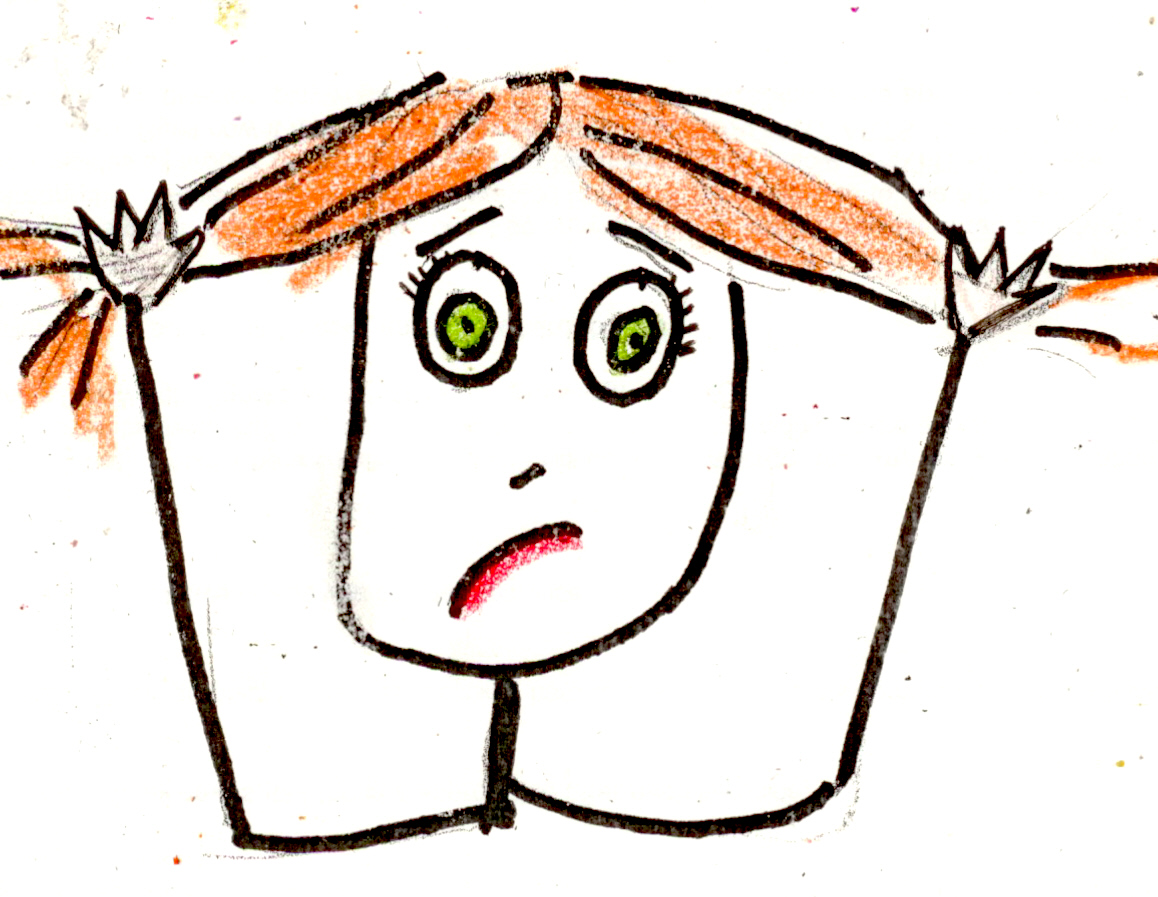
Cartoon Crazy
Image of crazy person tearing her hair out found here.

Because, as anybody who’s anybody knows, you can’t be trusted to administer a standardized test (no matter how many times over how many years you’ve done it) without going through at least one, usually two, sometimes (if you’re lucky and get chosen for a field test) THREE trainings a year on how to do it. The training consists of a power point presentation that tells you not do things such as give a student an answer, hint at an answer, or “act out” an answer. Yes, really.

(Note: If I had a blood pressure machine in my house right now, I could prove to you that, even twenty months after quitting teaching, the very thought of standardized testing still has a profound physical effect on me.)

zebrastress
I found this cartoon here.

There’s a lot of truth to that nightmare I had. Testing is a stressful experience, and not just for the students. Teachers are under a lot of scrutiny during standardized tests, and we’re being scrutinized for really ridiculous things. One year an auditor from either the state or the district (I’m not sure which) came into my room during the test with her official clipboard. She looked around to make sure all educational materials and posters had been taken down or covered up, wiggled the mouse on my computer to make sure it was off, and perused the testing documents on the table at the front of the room. She peered at the state-mandated seating chart and then crooked her finger for me to come over there. I did. She then indicated, with gestures and whispers, that I had neglected to mark where the door to the classroom was on the seating chart. I picked up my pencil and wrote the word “door” in the proper location. She nodded and left.

(Note: The year of the first TAKS Writing test, I actually broke out in the only case of hives I’ve ever had in my life.)

Then there was the time, during my second-to-last year of teaching, when I was unlocking the cabinet after the lunch break to retrieve the tests to hand them back to the students (because they must be under lock and key during breaks), and I managed to break my key off in the lock. I stood there with my back to the students contemplating the paths my life had taken to lead me to this point when I heard a girl’s voice say, “Ms. Juettner, did you just break your key?” Um… And then a boy’s voice say, louder, “Oh my god, are our tests stuck in there?!” UM… Thankfully, a counselor was sent to the rescue (because he had a screwdriver, not because I needed to be counseled, though some therapy later probably would have been a good idea) and soon we were back to our silent and serious testing atmosphere. But it was touch and go for a few minutes there.

(Note: Our school’s system for teacher restroom breaks during testing involved clipping a little red sign to the outside of your door when you needed to be relieved (in order to relieve yourself) and then waiting for a relief person to show up. Sometimes the relief person was already relieving someone else. Sometimes they didn’t see the sign. Sometimes they were reading the newspaper and forgot that teachers’ bladders were about to explode. There is an art to determining when it is exactly fifteen minutes until you are going to have to pee, and I never mastered it.)

no-thinking-allowed-vector

Beyond the monotony of the trainings, beyond the stress of following all the rules, beyond the various physical ailments that it causes in otherwise healthy individuals, the absolute WORST thing about standardized testing is the mind-numbing boredom of “actively monitoring” students for five hours a day, up to four days in a row. No grading. No computing. No reading. No writing. No talking. No napping. No making any noise. No telling how long until your next bathroom break. MIND. NUMBING.

One year, a few minutes before testing began, we were all standing in the hallway outside our classrooms, soaking up our last precious moments of freedom, when my friend Julie walked up and said, “Anybody got any problems you need worked out? Any relationship issues? Financial woes? Decisions about what to do with your life?” We all stared at her. She said, “I need something for my brain to work on while I’m in there. Come on, give me a problem to solve!”

I couldn’t supply Julie with a good life problem that day because the biggest thing on my mind at the moment was the same thing. What the heck am I going to do with my brain for the next five hours?

A few days after my recent nightmare, I came across the Love, Teach blog, which I’m now following (and you should too). The first post I saw was “16 Things You Can Do While Actively Monitoring Standardized Testing (Or The Next Time You’re Crazy Bored)” and, let me tell you, she has some GREAT suggestions. You should check them out. Then I’ll round out the list with my four favorite things, making it an even twenty.

human brain don't shake
I found this cool image here.

17. Gamble

Place bets with yourself about which row of students will finish the test first or turn the seating chart into a big bingo board and see how long it takes to get BINGO.

18. Play Matching Games

Since students aren’t allowed to keep anything at their desks during testing, they have to place all of their lunches and silent reading books at the front of the room. My favorite game was trying to match the students to their books and lunches. Since some of them brought multiple books, it was a real challenge.

19. Practice Your Math

If there are twenty-six students in the room, and nine of the students are wearing blue, what percentage of students is wearing blue? (Yes, monitoring standardized testing is so mind-numbing that my brain sometimes CHOSE to do math!)

20. Write Poetry

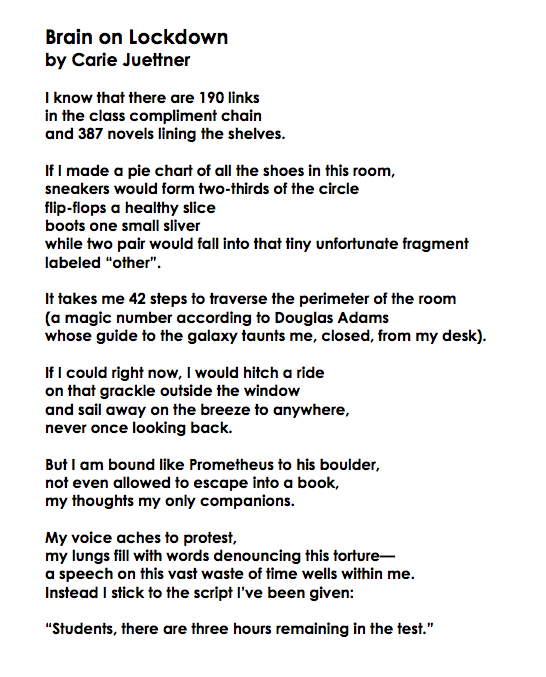
Technically speaking, you are not allowed to write while monitoring. But the rules do not specifically state that you are not allowed to carry a piece of paper and a pen in your pocket with which to scribble lines of poetry during restroom breaks. I wrote a few poems during my TAAS and TAKS and STAAR monitoring days. Unfortunately, most of them were about monitoring standardized tests. (The whole experience really saps your creativity.) See exhibit A below:

Brain on Lockdown Poem

As we head into yet another testing season, my heart goes out to all of my friends still in the classroom. I wish you interesting internal imaginings, great epiphanies, and absolutely NO highlighter marks on the answer documents. Good luck to you.


[To read more stories from my teaching career, check out my Teaching Stories page.]