I’m not usually a big celebrator of Valentine’s Day, but this week I received a few special treats that brought a big smile to my face.
On Wednesday, the elementary school where I work part time as library clerk showed their appreciation for me with breakfast from Torchy’s and a gift card from BookPeople. Books and tacos? Um, yes please! What a great way to make someone feel special! Then on Thursday, the love continued when Nerdy Book Club, one of my favorite blogs, shared my review of Jerry Spinelli’s Stargirl, one of my favorite books. It was an honor to guest post for them!
On Friday, my long-time Valentine celebrated a big birthday. Gink, panther extraordinaire, turned sixteen years old. We commemorated the occasion with cuddles, tuna, and looking down our noses at the other members of the household. (Gink’s a bit conceited, but I love him.)
And today, I spent the morning at a workshop offered by the Writers’ League of Texas. “Finding the Write One: Wooing a Great Critique Partner and Being One Yourself” by Nikki Loftin, author of Nightingale’s Nest and the soon-to-debut Wish Girl, was the perfect way to start off my Valentine’s Day. Not only did I learn the good, the bad, and the ugly of critique partner relationships, but I also made some great connections with other local writers.
Now I get to spend the rest of the day with my awesome husband, who listens to my stories, encourages my writing, and shares my love of books, cats, and breakfast tacos. (Breakfast tacos most of all.) It’s been a lovely week indeed. 🙂
Happy Valentine’s Day, everyone!
(If you have a comment about my Stargirl review, please post it on the Nerdy Book Club site.
Otherwise you can share your thoughts here.)
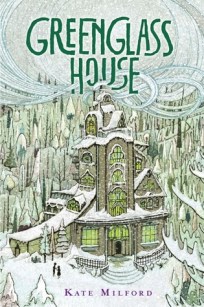
It’s only February, and already I know what one of my favorite books this year is going to be. Honestly, I knew it on January 19 when, only a hundred pages in, I closed my library copy of Greenglass House and decided to buy my own. I knew it again a few days later when I found myself belly laughing and then crying—big tears rolling down my cheeks—both while reading the same chapter. Sometimes stories get to us in the moment, but their effects fade over time until we look at a Goodreads rating months later and think, “Really? I don’t remember it being that good.” But I gave Kate Milford’s novel 5 stars without a doubt in my mind that the score will stick. Greenglass House is just that kind of book.
What It’s About:
Milo lives at Greenglass Inn with his parents, who adopted him when he was a baby. He loves his home—a huge quirky inn of stained glass that sits atop a hill overlooking a harbor and is known for housing smugglers—and he loves his parents, even though he can’t help but wonder about his other family, the one he’s tied to by blood. These wonderings cause him heavy guilt, so he tries to suppress them, with difficulty. Although Milo loves his home, he looks forward to winter break when the inn is empty and quiet and he gets his little family all to himself for a few weeks of snow and holiday magic. But this winter break, things are different because strangers—strange strangers—keep showing up at the inn during the off season, and soon the house is filled with mysterious guests and mysterious stories and mysterious objects which all seem to have something in common—Greenglass Inn itself. Milo’s tidy world is tipped on its side, and he’s close to having a meltdown, but when Meddy, the cook’s daughter, suggests they try to solve the mysteries by going on a campaign via an old role-playing game called Odd Trails, Milo’s vacation is salvaged. He discovers that creating a character only loosely based on himself (a blackjack named Negret) helps him to learn his own strengths and allows him to fantasize about his past without betraying the ones he loves. Milo/Negret and Meddy/Sirin take the reader on a delightful and touching adventure full of as many colorful facets as a stained glass window.
What I Loved About This Book:
The Setting – Greenglass Inn has everything a kid could want in a house—multiple floors, an attic full of interesting old stuff, fire escapes, creaky stairs, and mysteries to solve. Plus, it’s snowing outside, and about every four pages, Milo drinks some hot chocolate by a fire. (Warning: This book will make you want hot chocolate. A lot.)
Milo’s Parents – In so many children’s books, the parents are aloof or unbelieving or too busy to notice the adventures their kids are having. I think the idea is that you have to get the parents out of the way in order for adventure to be possible. Not so in this book. Milo’s parents are so loving and caring and understanding, and yet they don’t seem the least bit cheesy or flat. I love them. And Milo loves them. And they love Milo. And despite all of this, Milo still feels guilty when he thinks about his biological family. Why? Because kids are kids and they worry about things they shouldn’t worry about. That’s life. This book is a love letter to adopted children and to families in general. It says it’s okay to be happy and to wonder at the same time.
The Gaming Aspect – I’ve recently started dabbling in role-playing games myself (I’m playing a 6th level Elf Druid named Gleep in Pathfinder if you must know) and it was so much fun to see that world come alive in this book. I loved it even more that Meddy is the one who introduces it to Milo, chipping away at that stereotype that “girls don’t play games.”
Chapter 10 – The chapter about Christmas Eve begins with a hilarious scene in which an unlikely pair attempts to bake a cake together. Then it develops into an extremely touching moment that involves some very special Christmas gifts. I laughed, I cried, I loved this book even more.
The Little Details – The description of the pull-string lights in the attic, the tradition of the silver bells on the Christmas tree, the way Milo’s idiosyncrasies are apparent but not over the top… I could go on, but I won’t. Just know that there is more to this book. Surprises lurk in its pages. You’ll just have to read it to discover them all. I found myself wanting to re-read it as soon as I was done.
Any Complaints?
The only negative thing I can think to say about this book (and I’m not sure why I’m even looking for something) is the chapters are pretty long. Most are around twenty-five pages with some up to thirty-five, which is a little odd for a children’s book. It wasn’t a problem for me, but I’ve found that short chapters appeal to many kids, so some younger readers might be intimidated by the length between breaks. If your child or student is struggling with the chapter lengths, tell them it will be worth it. Or read the book to them instead. I think this is a perfect novel for families to read together.
One More Reason to Buy This Book:
I learned about Greenglass House on Nerdy Book Club’s list of 2014 Nerdy Awards for Middle Grade Fiction, and I decided to check it out from the library. Less than halfway through, I knew I needed to buy it. When I went to Barnes & Noble, there were no copies on the shelves, so I asked about it. I was told there were three in the back and the sales clerk went to get me one. When she came back with my copy she said I was lucky because the books were being sent back to the publisher but hadn’t shipped out yet.
I was shocked. I’m not the only person who loved this book. You can read multiple glowing reviews on Goodreads and it has an average rating of over 4 stars. But apparently people don’t know about it. I was so heartbroken that these books had been removed from the store’s shelves that I wanted to buy them all, to save them. In the end, I didn’t.
But you can. Buy Greenglass House for yourself or your child or your friend or your classroom. It deserves to be read and shared.
Last week, I took a random walk on an empty trail. In between errands to the library and the grocery store, I pulled my car over and stopped on the side of the road by a little hiking trail I’d only been on once before, deciding to take a stroll with nothing but my cell phone and my journal for company. Noting the absence of other cars, I texted my husband letting him know where I was. It was a sunny Tuesday afternoon in a nice neighborhood, but still… safety first.
I set out on the two-mile path, listening to the birds and the squirrels, enjoying the breeze on my face and the crunchy feel of my sandals on the dirt. I stretched my legs, took deep breaths, enjoyed the oneness with nature, mentally patting myself on the back for taking this spontaneous jaunt off the cement and into a few minutes of peaceful meditation.
Coming upon a picnic table, I decided to stop and write in my journal. Write what? It didn’t matter. Maybe I’d pen a poem or try to capture the flit of feather and shuffle of leaf that provided such a soothing background to my solitude. Or, more likely, I’d put to words that self-congratulatory feeling I’d been having over my decision to go for a walk. Oh how intelligent I am! Oh how thoughtful! No one has ever had such a brilliant idea as this! It’s amazing how many of my former journal entries sound this way.
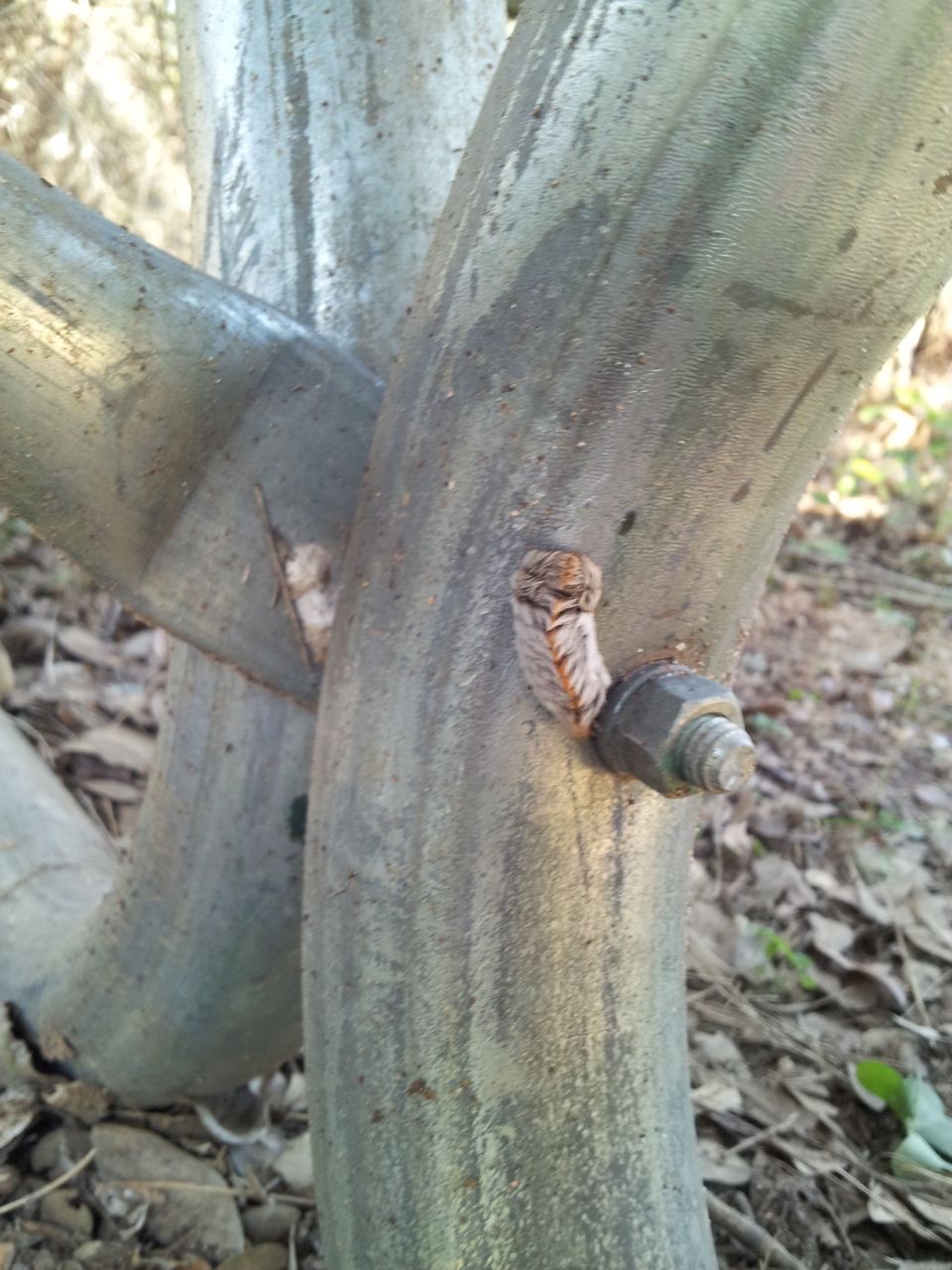
I’d yet to put pen to paper, though, when I crossed my legs beneath the wooden table, getting comfy for whatever witticisms I was about to write, and glanced down. Why did I glance down?—Out of habit? To perfect the angle of my crossed legs? To make sure I didn’t kick the imaginary person sitting across from me? To check for monsters?—Whatever the reason, I glanced down, and there on the metal bar beneath the table, not three inches from my bare knee (bare because I was wearing shorts because while it was January, it was also Austin, Texas) there was a stinging thing.
“Stinging thing” is not the scientific name for the fuzzy, mohawked caterpillar wriggling so close to my bare skin. It actually has many names. Megalopyge opercularis seems to be its formal title, but it goes by puss caterpillar in some parts and in others (including where I grew up) it’s called a tree asp. But no matter what you call it, it’s a nasty little fellow. The venomous spines in its “fur” pack a powerful punch to human skin, causing severe pain that can radiate up the affected limb, bringing on burning, swelling, headache, nausea, rash, and difficulty breathing. I’ve never been stung by one myself, but I remember the time my mom laid her wrist on a tree asp on the top of our gate when I was a little girl, and the memory is the only deterrent I’ve ever needed to keep me from messing with them.
It’s not as harmless as it looks.
The second I saw that hairy bug, everything changed. Gone was my feeling of peace and serenity, gone the happy chatter of birds. All of a sudden the trees were alive with things that sting and the snapping of twigs no longer brought images of squirrels. Maybe a dark cloud really did pass by overhead at that moment or maybe my goosebumps just made it seem true; either way, the warmth of the sun had left me. My unplanned walk in the woods suddenly seemed impulsive rather than spontaneous, foolish rather than carefree. Everything around me screamed danger.
I closed my journal, carefully lifted my legs over the table’s bench, and walked swiftly back to my car, cell phone in hand, arms held close to my body, shivers all over.
What, you must be asking, does this have to do with The Shining?
First, you should know that I’m talking about the book, not the movie. And if you’ve read it, you probably understand.
Reading The Shining, which I’m a hundred pages from finishing right now, is like noticing that tree asp over and over and over. The Shining can make a sunny day feel dark. It can take an innocent thought and turn it into something sinister. It poses disturbing questions that hang over your head long after you’ve closed the book and made dinner, questions like, What’s really going on in the heads of my loved ones? and How close are any of us from snapping? Stephen King’s story gets into your mind, into your bones, into your sleep. It sucks you in until you look up from the page (or wake up from your nightmare) and blink into reality (are you sure?) and wonder how long you’ve been gone.
And that’s what I love about it.
Page by page, this amazing work of horror is cementing itself on my list of favorite books. I read it slowly on some days and then in great quick bursts on others because I simultaneously never want it to end and can’t wait for it to be over. I love the Jack Nicholson movie (and reading the book is not making me love it less) but there are more—so many more—things that sting in the original, including wasps, which are absent from the movie but play a prominent role in the book. That’s one insect whose sting I do know first hand, and every time those flying fiends are mentioned, I feel creepy-crawly all over.
One hundred pages to go. One hundred pages until the sun comes out (hopefully) for good. I don’t think I’ll go on any more solo hikes until I finish.

 On Wednesday, the elementary school where I work part time as library clerk showed their appreciation for me with breakfast from Torchy’s and a gift card from BookPeople. Books and tacos? Um, yes please! What a great way to make someone feel special! Then on Thursday, the love continued when Nerdy Book Club, one of my favorite blogs, shared my review of Jerry Spinelli’s Stargirl, one of my favorite books. It was an honor to guest post for them!


 Carie Juettner