11 Modern Picture Books That Make Great Baby Shower Gifts

Books make the best gifts. Period. And buying a book for a baby shower means not having to set foot inside a Babies R Us or search through online registries full of products called Chew-Choos and Boogie Bulbs. I don’t know what either of those are, and I don’t want to.

Plus, these particular books make great gifts because they were all published after the year 2000. Everyone loves the classics—Where the Wild Things Are, The Giving Tree, Mike Mulligan and His Steam Shovel, everything by Dr. Seuss—but many families already own those well-loved titles. If you choose a book off this list, there’s a good chance the baby-to-be’s parents don’t already have a copy. (Unless of course they’re teachers or librarians, in which case they’ll be impressed with your impeccable taste in literature.)

It’s important to point out that these aren’t board books (the thick-paged tomes made for young babies with a stronger appetite for grabbing and chewing than for reading). Most of these are aimed at children ages four through eight, but they still make great baby shower gifts because:
A) Books don’t go bad.
B) It’s never too early to start a child’s library.
C) These are books that parents will enjoy reading too. They’re creative and sweet and thought-provoking and hilarious and, in the case of I Want My Hat Back, a little bit shocking. Plus, a couple of the books in this list will help prepare Mom and Dad for some of the precious predicaments they’re likely to encounter in parenthood.

One more note: I do not believe in genderizing gifts for kids, especially books. You won’t find any advice here about gender. If you’re wondering if the book is good for girls or boys, the answer is yes. I would give any book on this list to any child.

MollyLou

1. Stand Tall, Molly Lou Melon

Written by Patty Lovell, Illustrated by David Catrow – 2001

“Molly Lou Melon had buck teeth that stuck so far out, she could stack pennies on them. She didn’t mind. Her grandma had told her, ‘Smile big and the world will smile right alongside you.’ So she did.” I love everything about this book, from the quirky little character to the colorful illustrations to the great message about being yourself even when faced with adversity.

Knuffle_Bunny

2. Knuffle Bunny: A Cautionary Tale

Written and illustrated by Mo Willems – 2005

If you’re not acquainted with Mo Willems, you should be. He’s written dozens of children’s books and they’re all amazing (and difficult to keep on our library shelves) but Knuffle Bunny is my favorite. This cute father/daughter story about what happens when a beloved stuffed animal gets left at a Laundromat uses a combination of color drawings and black and white photographs to create unique images. Also, it’s the first in a series of three books, so it lends itself to more great gifts in the future.

BookEating

3. The Incredible Book Eating Boy

Written and illustrated by Oliver Jeffers – 2007

Henry loves books. The problem is he loves to EAT them. Luckily, he figures out there’s a better way to ingest the information, one that doesn’t make him sick to his stomach. Oliver Jeffers uses a unique artistic style that adds layers of pleasure to this cute, creative story.

AllTheWorld

4. All the World

Written by Liz Garton Scanlon, Illustrated by Marla Frazee – 2009

Rock, stone, pebble, sand
Body, shoulder, arm, hand
A moat to dig, a shell to keep
All the world is wide and deep

The simple words and beautiful pictures in this book will stay with you long after you read it.

BossBaby

5. The Boss Baby

Written and illustrated by Marla Frazee – 2010

Having a baby changes everything. This adorable book paints a hilarious (and accurate) picture of what life is like once the new “boss” arrives.
Shark

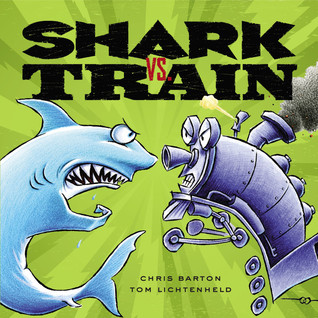
6. Shark vs. Train

Written by Chris Barton, Illustrated by Tom Lichtenheld – 2010

Who will win? Shark? Or Train? Well, it really depends on the scenario. I mean, swimming is kind of a no-brainer, and when it comes to carnival rides, Train has an obvious advantage. But what about selling lemonade? Or roasting marshmallows? This book is hilarious. I love it.

PressHere

7. Press Here

Written by Hervé Tullet, Translated by Christopher Franceschelli – 2011

This interactive picture book is SO simple and SO creative. It’s one of those books that made me scream, “WHY DIDN’T I THINK OF THIS?” Well, I didn’t, but I’m really glad Hervé Tullet did.
Hat

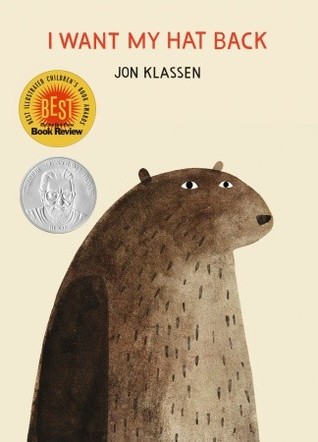
8. I Want My Hat Back

Written and illustrated by Job Klassen – 2011

The bear’s hat is gone. He wants it back. This simple tale will help teach kids how to make inferences while they read, but it does have a slightly controversial ending. (See, now you HAVE to read it!)

Monster

9. The Monsters’ Monster

Written and illustrated by Patrick McDonnell – 2012

I love the artwork in Patrick McDonnell’s comic strip, Mutts, and I’m partial to all children’s books that are spooky, creepy, or Halloween-related, so this one is right up my alley. The Monsters’ Monster is not actually creepy though, it’s sweet.
OnceUpon

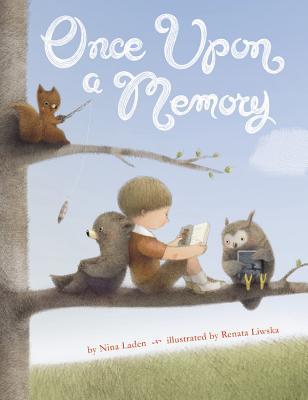
10. Once Upon a Memory

Written by Nina Laden, Illustrated by Renata Liwska – 2013

Does a feather remember it once was a bird?
Does a book remember it once was a word?

This poetic picture book will put a smile on your face and one in your heart.

GrandfatherGandhi

11. Grandfather Gandhi

Written by Arun Gandhi and Bethany Hegedus, Illustrated by Evan Turk – 2014

This nonfiction picture book, co-written by Mahatma Gandhi’s grandson, teaches kids a powerful message about how to turn anger into peace, and darkness into light.


*** BONUS BOOK ***

HaikuMamaHaiku Mama: Because 17 Syllables Is All You Have Time to Read, by Kari Anne Roy – 2006

Yay! The perfect time
to strip down naked and scream–
when Mommy’s on phone

This one’s for Mom. This collection of hilarious (and honest) haiku covers everything from nap time to potty training.

***

Happy Shopping!

[Is there a modern picture book that needs to be on this list?
Share it in the comments!]

Driven to Distraction: How to Avoid Losing Focus When Writing

The internet gets a bad rap. People are always talking about what a time suck it is and how “these days” we have such difficulty staying away from distractions. While I agree that it’s easy to get lost in social media, educational blog posts, and cute pictures of puppies, the interwebs are not solely responsible for the downfall of humanity. People have always struggled with focus.

Don’t believe me?

I recently read a short story by Bram Stoker called “The Judge’s House.” It was written in 1891. This is how it starts:

“When the time for his examination drew near Malcolm Malcolmson made up his mind to go somewhere to read by himself. He feared the attractions of the seaside, and also he feared completely rural isolation, for of old he knew its harms, and so he determined to find some unpretentious little town where there would be nothing to distract him. He refrained from asking suggestions from any of his friends, for he argued that each would recommend some place of which he had knowledge, and where he had already acquaintances. As Malcolmson wished to avoid friends he had no wish to encumber himself with the attention of friends’ friends, and so he determined to look out for a place for himself. He packed a portmanteau with some clothes and all the books he required, and then took ticket for the first name on the local time-table which he did not know.”

See? Over a hundred years ago, this character took a train, alone, to a town he didn’t know, then rented an old abandoned house which local villagers claimed was haunted, all in a desperate attempt to escape distraction while he studied. Of course, this decision worked out very poorly for Malcolmson in the end, so I suggest using these less severe methods for keeping yourself on task.

Screen Shot 2015-06-23 at 6.05.33 PM

1. SelfControl

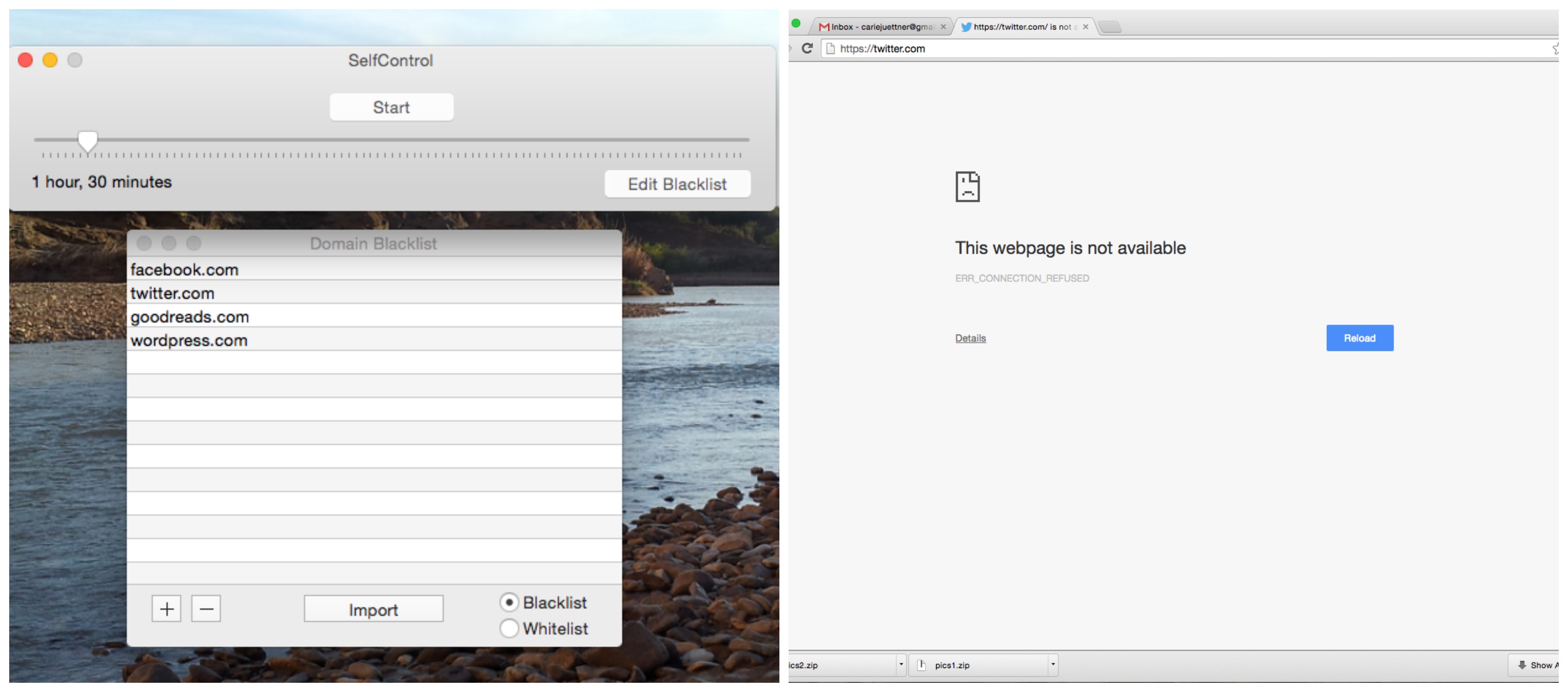
No, not actual self control. Everybody knows that doesn’t work and I have an empty bag of Milanos in my trash can to prove it. I’m talking about the app. SelfControl is a free app for Mac that allows users to block distracting websites for a certain amount of time. You control the websites and the length. So if you’re doing research and need some internet access, that’s fine. You can still block Facebook, Twitter, Goodreads, or any other urls that frequently try to grab your attention. I find it very useful and usually set it for an hour or hour and a half block.

SelfControl

2. The Green Folder

Sometimes shutting off the internet isn’t enough because the distractions aren’t in the computer– they’re in your own brain. (The call is coming from inside the house!) Sometimes you’re working on a project and you’re really in the zone and it’s going great and you’re getting so much done and all of a sudden your brain is like, “Wait! Oh my god, I just had the BEST idea! What if…” and then she proceeds to tell you the basic plot of a novel that would absolutely 100% be a bestseller. When this happens, it’s temping to stop what you’re doing and just type up a few words of it, maybe a rough outline, so you don’t forget. Don’t do that! It’s a trap! If you go down that rabbit hole, the next thing you know it’s two o’clock in the morning and you’re stuck in the middle of a chapter of THE WRONG NOVEL. No. Don’t do it. Then again, simply ignoring her isn’t a good idea either because, damn it, Brain’s really onto something this time. So here’s what you do instead:

  • Get a folder. (An actual, physical folder, not one on your computer. Mine is green, but the color is optional.)
  • Keep the folder on or near your work space.
  • When Brain comes up with a BRILLIANT idea, jot it down on a sticky note and put it in the folder. (Or write on the inside of the folder itself as I have done.)
  • Keep the folder CLOSED. Now all of Brain’s ideas are safe and sound but out of sight.

TheGreenFolder

I think it’s important that this is a physical folder in the real world and not one on your computer. Computer files are too easy to access when you’re looking for somewhere to stray while typing and it’s a lot more satisfying to close a real paper folder than to click the red x of a digital one.

Of course, the folder shouldn’t stay closed forever. After all, there’s some good stuff in there. Set a timer on it the same way you do with the SelfControl app. My green folder is closed for the month of June while I work on my novel revisions. It’s accumulating everything from poem ideas to possible blog posts to flyers about future writing contests to… I don’t even know what anymore. On July 1st, I get to open it and see what’s inside. It’ll be like my birthday!

3. Get Away

Malcolmson actually had a pretty good idea in “The Judge’s House.” Sometimes turning off the internet and sticking distractions in a folder still isn’t enough to keep you in the chair and writing. Those are the days when a change of setting can do you good. Some people write in coffee shops—that usually works for me for a couple of hours—but if, like Malcolmson, you need a quiet space for a lengthy period of time, the hustle and bustle of your favorite coffee shop may not work.

Luckily, if you live in Austin, Texas, like I do, you don’t have to go to a haunted house to find the perfect place to work because we have The Writing Barn, a unique space operated by Bethany Hegedus, author of Between Us Baxters, Truth with a Capital T, and the Bluebonnet Award Nominated picture book, Grandfather Gandhi.

From The Writing Barn website:

Situated on 7.5 wooded acres in Austin, Texas, The Writing Barn is surrounded by mature trees, home to birds and deer. It’s a peaceful out-of-town environment without ever leaving Austin.

With floor to ceiling bookshelves, rows of instructional craft books, free wi-fi, and no television, The Writing Barn is the perfect spot for an overnight writing retreat, to host a writing class, or throw a book launch party.

TheWritingBarn

In addition to workshops and classes, the Barn also hosts “Write Away” days where, for just $15, guests can spend the day at the site, enjoying hours of distraction-free* work time among other writers. These days are so great for getting back into the groove if you’ve been away from a project or focusing to get through a troublesome revision or just enjoying the peace and serenity of the surroundings while typing. In fact, I just took part in a “Write Away” day today and I left the Barn with 4,000 revised words of my novel, half of this blog post drafted, and six new friends.

* Okay, it’s not completely distraction free, but baby deer are allowed to interrupt me anytime.

That’s all I’ve got today. Limit the internet with SelfControl, stick your Brain’s brilliant (but ill-timed) ideas in a folder, and find a writing retreat in your area (but good luck finding one as lovely as The Writing Barn). And if you do decide to go off on your own for awhile, remember—safety first. Tell someone where you’re going, take your cell phone with you, and heed the warnings of the local villagers if they say the house you rented is haunted. Because, after all, you’d eventually like to be able to get away from your get-away.

The Girl in the Attic

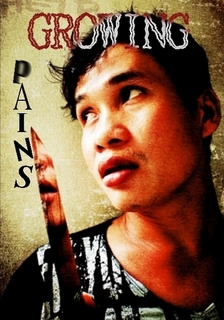
GrowingPains

I’m excited to announce that my short story, “The Girl in the Attic,” came out today in Growing Pains, a youth horror anthology from Sinister Saints Press.

I’m psyched about this anthology because A) kids love to be scared and B) what’s more terrifying than the teenage years? Growing Pains brings it all together.

Here’s the description of the book from Sinister Saints:

“Growing up has always been difficult. There’s peer group pressure to contend with, teenage angst, making social connections, acceptance, finding out who you are and what you want… So add psychopathic tendencies, crazy families, hidden secrets and loopy la la crushes into the mix and you’ll be lucky to hit puberty! Join editor Rich Dodgin and the authors from imprint Sinister Saints Press for this horrific ‘coming of age’ collection.”

The mention of “crazy families” and “hidden secrets” brings to mind my piece in the anthology. Here’s a little teaser:

“The Girl in the Attic”
by Carie Juettner

The door, which was nailed shut with one hundred and eight silver nails, had not been opened in sixty years. The girl, who had just turned twelve, stood in front of the door, thinking. The hammer, which dangled from the girl’s right hand, belonged to her father, who was not home.

Lydia had always wondered what was behind the attic door… But every time someone saw her with a hammer, they took it away from her and made her play outside. She could never catch a break.

Until now.

To find out what’s behind the attic door, buy a copy of Growing Pains!

P.S. My story is in good company. The anthology also includes work from my World Horror Con roomie Ashley Davis and fellow Austin author Rie Sheridan Rose. I’m honored to be published alongside them.