
The title of today’s post comes from one of my favorite moments in…
[If you haven’t seen it, do yourself a favor and watch this two-minute clip on YouTube. If you like stop motion animation or motorcycle sidecar humor or sheep, you won’t be disappointed.]
To be writers, we must be creative, imaginative, artistic, and open to the clutter and chaos of our minds. However, to be successful writers, we must also be organized.
Fortunately, organization is one of my strong suits. Keeping things in order has served me well in my teaching life, my home life, and my writing life. So, if your creative process is starting to resemble a messy sock drawer (*shudder*) or a kitchen pantry with absolutely no thoughtful purposing of the shelf space (*double shudder*) or the master closet in my husband’s house before I moved in (*oh the horror!*) then I hope these tips can help you reign in the madness just a little bit.

Tip #5: Set Up a System
Some people simply want to write “when the mood strikes.” They think structuring their writing time into a schedule will take away the passion of their art and mess with their muse. That format works so long as things are going well and the words are flowing, but eventually your muse is going to call in sick or skip down to visit her mom in Florida or read a book about organic gardening and suddenly decide THAT’S what she wants to do with her life. (Muses are fickle little creatures.) If you want writing to be more than just a hobby, then you’re going to have to produce work even when your muse is babbling on about soil pH to the woman giving her a pedicure in Tampa.
On the flip side, a lot of authors say that you should have a regular routine where you write at the same time every day. (I can’t say those words without picturing a drill sergeant with a scowl.) It’s a great idea, and I’ve tried to make it work, but I just can’t. Too many other variables get in the way. Some mornings I have yoga. Some afternoons I attend Meet-Ups. Some weekends I have book club. Some nights my husband and I eat popcorn with the dog and watch Game of Thrones. There are not four consecutive hours in every day of the week that are free to write, and none of those other activities are negotiable. Each one (exercise, networking, talking about books, relaxing family time) are all integral to me being a happy, healthy writer.
So instead of a daily routine, I set up a weekly one. I keep my weekly schedule on a bulletin board by my desk. The items are made up of color-coded sticky tabs, which make it easy for me to switch things up. I redo my schedule about every two months because… A) Life obligations and class schedules change. (When the weather gets hot, I like to swim, so my routine is affected by pool hours.) And B) It’s just nice to mix things up. I’m great about following plans and schedules until they become old hat. Then I need something new to get me going again. Changing things up every few weeks gives me new energy and motivation.
Rather than show you my whole weekly schedule (I like you people, but I don’t exactly want you to know where I am every second of every day) I’ll just give you a couple of the writing-related highlights.
- Sundays = Goal-setting. I come up with three or four specific, high-priority, achievable goals for the week. I post them in my office and email them to my critique group friends so they can help keep me on task.
- Thursdays = Get out of the house. I meet a friend at a coffee shop to work. We generally stay from about 10:00 to 2:00. Since that’s a long time for me to focus on one task, I come prepared with more than one item on my to-do list. I might finish a chapter or draft a blog post, then move on to critiquing a colleague’s work or reading a Writer’s Digest article.
- Fridays = Save & Assess. Every Friday, I back up all of my files. (I use Dropbox to do this, but there are other options too.) I used to be really bad about remembering to back up my work, but now that it’s “on the schedule” it gets done. Then I look back at my weekly goals and assess my progress. If I’m almost done, I get to finish up and spend the afternoon doing something fun. If not, it’s back to work. (Note: It’s usually back to work.)
This schedule is not set in stone. (As I mentioned before, it’s in sticky tab form.) While it gives me a solid framework for my week, it still leaves plenty of wiggle room for when my muse waltzes back in the door like nothing’s happened and plops herself down in my desk chair with a smile.
Every writer’s system is going to look different. Your schedule may be limited by a full time job or kids or both, but you should try to get the most out of however much (or however little) time you have to write.
If nothing else, set aside a time each week to ask yourself the following questions:
- What are my goals?
- Which goal is my top priority?
- What’s my deadline for accomplishing this goal?
- What’s the first step to meeting that deadline?
- How long has it been since I backed up my work?
The time it takes to answer these five questions will be time well spent. Then you can build the rest of your writing week from there.
Tip #6: Document Thyself
Setting up a daily or weekly schedule is about the BIG picture: setting goals, making time to write, getting things done. If you do it right, you’ll soon be doing just that—producing. And once you start producing, you’ll start submitting your work to the world.
Next comes the nitty-gritty side of staying organized. You have to keep track of what you submit and where and to whom. How will you know if it’s time to start biting your fingernails over those contest results if you don’t know when the contest ends? How embarrassing would it be to accidentally send the same poem to a journal twice because you forgot they already read it (and rejected it) before? Keeping a log of all your submissions will help avoid these blunders.
I use Excel files. I create one for each year of submissions, then I have a separate file for all of my published work and awards.
Here’s a sample of what my submission tracker looks like. All of the information on this one is fake, but you probably figured that out already.

Note: SS stands for simultaneous submission. Some publishers don’t mind, but most of them want an exclusive look at your stories and poems.
Here’s a downloadable copy. Feel free to use this format to make your own.
Carie_Juettner_Sample_Submission_Tracker
Here’s how I format my publications and awards file. This information is real, but not complete. To see more of my published work, click here.

Note: It’s nice to have all of this information in one place when I am writing a bio or acknowledging the original publication of a piece I’m submitting to an anthology.
The first time I went to Annie Neugebauer’s website and clicked on The Organized Writer, I knew I’d found an organizational soul mate. She has a nifty little document for everything. No way are there any messy sock drawers or embarrassing junk closets in this woman’s home. No. Way. I suggest you spend some time perusing her offerings. She’s done all the hard parts for you!
Recently I decided it was time to seek an agent for my picture books. (You didn’t know I also write picture books? I do! I’m currently seeking representation for The Evolution of a Bark, where a simple dog bark evolves into a hilarious scene that’s entertaining for young readers and educational for middle grade students.) This being a new endeavor for me, I needed some guidance, so I modified Annie’s Agent Query Prep-work Chart into my own tool. Here’s a sample of mine (with some creative editing to protect identities).
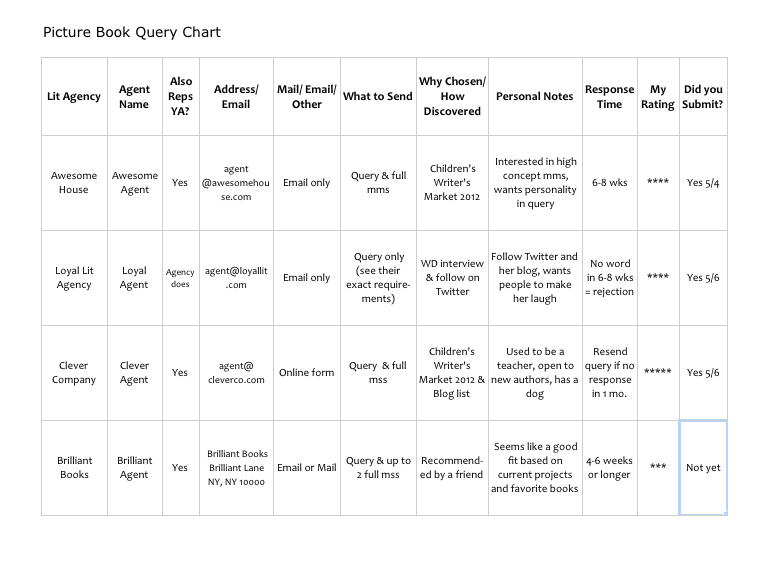
Note: MSS stands for manuscript. You may notice that most agents requested the full manuscript of my book. That is only because it’s a picture book. When it comes to novels, most agents want either a query only or a query and the first ten pages. Then again, some ask for three chapters and others only want a synopsis. That’s why these files are so important. It’s a lot of information to keep up with.
Staying organized is a job in itself, and it can be a difficult one at first, but once you get your system up and running and your files in order, the benefits are apparent and the maintenance doesn’t take up much time. And it’s not like you have to always be tidy. Anne Lamott says, “Clutter is wonderfully fertile ground.” Once in a while, it’s okay to lose yourself in a glorious mess.



 Carie Juettner