Autism Awareness And A Book Review: Anything But Typical


Books1PicMonkey Collage

I’ve been so caught up in April being National Poetry Month that I almost missed the fact that it’s also National Autism Awareness Month. Strangely enough, I actually read two books this month told from the perspective of a character with Asperger’s syndrome– The Rosie Project by Graeme Simsion, which is a romantic comedy for adults, and The London Eye Mystery by Siobhan Dowd, which is a young adult novel. I really enjoyed them. The Rosie Project is an extremely entertaining novel with dozens of laugh-out-loud moments, and The London Eye Mystery has compelling characters, realistic drama, and (most surprising to me) is also a very good mystery. I recommend them both.

While it is somewhat ironic that I happened to pick up these two titles during the month of April, it is no coincidence that I chose to read books about characters facing the challenges of Asperger’s. I have been drawn to stories that tackle this subject for years now, ever since I began meeting people on the autism spectrum in my classroom.

During my last eight years of teaching seventh grade English, I taught a dozen or so students who had been diagnosed with autism or Asperger’s, or who were undiagnosed but showed symptoms of the syndrome. I also interacted with several more students who were not in my classroom but who attended my school. The middle school where I taught was excellent at providing the support these students needed while also making sure they received the respect they deserved from adults and peers alike. I was proud to work there.

Working with students who faced these challenges inspired me to learn more and, since I prefer fiction over nonfiction, I looked to novels to give me glimpses inside lives of people with autism and their families. I read: Rules by Cynthia Lord, Al Capone Does My Shirts by Gennifer Choldenko, Mockingbird by Kathryn Erskine, and Anything But Typical by Nora Raleigh Baskin. This month, I added the two new titles to my list. I enjoyed all of these books, but my favorite was Anything But Typical. It provided, for me, the best insights into the minds of my former students. My full review of the book is below.

One more thing: Even though the books I’ve listed above have been well-received and, in some cases, have won awards, you will still find reviews criticizing them for portraying too unrealistic or too limited an image of people on the autism spectrum. I am not trying to disagree with those readers. These books are fiction, and I don’t believe that a book exists (fiction or nonfiction) that can truly teach me what it’s like to have autism. And even if it does exist, it would only show me one person’s perspective. Every person with autism is unique. Despite the collective label, despite the similar symptoms and behaviors, no two people are alike. Period.

If you’re interested in learning more about autism and Asperger’s syndrome, I suggest you head over to Autism Speaks after reading this book review.


Anything But Typical

Anything by Typical by Nora Raleigh Baskin

Anything But Typical is told from the first person perspective of Jason Blake, a twelve-year-old boy with autism and (therefore) a whole lot of acronyms to deal with, from IEP to NLD to PDD-NOS. Jason perceives the world very differently from NTs (neurotypicals) and his preference for silence over unnecessary talk and the way he avoids looking at faces (because trying to decipher them is distracting) can be frustrating for those around him, even (especially) those closest to him. Jason’s outlet, the place where he can express himself and show his creativity, is writing. He even makes friends with a girl on the Storyboard site where he posts his fiction stories. But when various coincidences lead him to a convention where he could come face to face with his new friend, Jason’s anxiety increases to new levels. He doesn’t want this girl to see him. He doesn’t want her to know.

This is a great book. It ranks right up there with some of my other favorite YA novels about kids who are different, like Rules by Cynthia Lord and Out of My Mind by Sharon Draper. Anything But Typical is told with touching honesty. As a former middle school teacher, I can say from experience that Baskin’s description of Jason’s behavior in the library when his favorite computer is in use is excellent. And her portrayal of Jason’s misunderstood relationship with his mother is both beautiful and heartbreaking. These few lines from page 68 sum it up for me:

“Isn’t it funny, Jason?” my mother is saying. “Isn’t it funny that when you were really little you wouldn’t wear a belt at all? Isn’t that funny?”
I love my mother so much.
“Remember, Jason?” she is saying. “Remember those leggings?”
We are both remembering the same thing.
“Those leggings?” I repeat what she has said, so she will know this.
“No?” my mother is saying. “You don’t? It’s okay. It was a long time ago. Well, let’s go, shall we?”

The book made me want a second chance at understanding some of my former students with autism and asperger’s syndrome and, more than anything else, it made me want to give their moms a big hug.

My only complaints about this book are minor. There were a few typos that were distracting because at first I was trying to figure out if they were purposeful due to the first person narrator, and I felt that Jeremy, the brother, acted a lot younger than his nine years. But overall I really enjoyed this story and I was very pleased that it did NOT end with Jason writing the book. That ending has been a bit over-done in YA lit and I thought for awhile that was where this novel was heading.

The Stories Books Tell

Books tell stories.

I know what you’re thinking—Duh. But I’m not talking about the ones between their pages. I’m not talking about their own stories, the tales they tell universally to anyone who reads them. I’m talking about the stories they tell to each of us, individually. Our stories.

That’s right. Books tell us our own stories. It’s just one of their many super powers.

AMonsterCalls

In the Author’s Note of A Monster Calls, Patrick Ness writes, “Stories don’t end with the writers, however many started the race.” This young adult novel tells the story of a grieving boy and a dying mother and a monster and a yew tree. But it also tells the story of two writers—Patrick Ness and Siobhan Dowd—connected by life and death and the stories in between. Dowd died of cancer at age forty-seven, leaving behind the notes for her next book. Ness, who’d never met her, turned those notes into a story that was part hers, part his, something new that he hopes she would have liked.

He’s right. Stories don’t end with the writers. I have a small library on the bookcases in my home– volumes of fiction, horror, young adult lit, poetry, memoirs, short stories, and reference books– but there are so many more stories stored on those shelves than you can see just by looking.

My poetry books and all their many stories tucked inside.

My copy of Good Omens, by Neil Gaiman and Terry Pratchett not only tells a very funny story about the apocalypse, it also tells a very sweet story of a couple falling in love. When my husband and I first started dating, we read that book together, taking turns reading aloud to each other, sharing laughs and lingering looks. I loved the book—it’s hilarious and you should read it. But when you do, you’ll only get half the story the book tells to me when I look at it.

Louis Sachar’s Sixth Grade Secrets, which I read in the sixth grade and then re-read last month, was one of my favorite books as a kid, but in addition to telling the story of secret clubs and mean pranks and first crushes, it also tells the story of one of my most shameful moments. In the seventh grade, I used one of the pranks from the book on one of my best friends and made her cry. I don’t know why I did it. Maybe I was a mean kid, or maybe I just wanted to see if it would work. It did, and I have regretted it ever since. Whenever I hear people complaining about movies and TV and video games being bad influences on kids, I think of this—how I got the idea for my cruelty from a book.

[Note: Despite the fact that it brought out my bad side, Sixth Grade Secrets is still a good book, and it holds up well twenty-five years after it was written. I was particularly impressed, during my recent reading, at how “un-girly” the girls are in the story, which is to say, they are simply girls, which is to say, they are simply people, with varied styles, interests, and personalities. The generic stereotyped fashion-freak girls that inhabit some of today’s YA are nowhere to be found in Sachar’s sixth grade world.]

This book certainly has some stories to tell. Image courtesy of Thomas Cutter, middle school teacher.

Personal memories aren’t the only things that add layers to books. Sometimes it’s something else, like a connection outside in the world. I remember once, many years ago, I was reading The Outsiders by the pool at my apartment (this was early in my teaching career, before I had the book almost-memorized) and the moment my eyes landed on the word “train” I heard a train whistle off in the distance. Recently, when I was listening to Angie Sage’s Queste in my car, just as the narrator read the words “wizard castle” I glanced up to see a sign for “Wizard Castle Tattoo.”

These things happen more often than you might think. When they occur, I feel like the universe is reading over my shoulder, providing sound effects and illustrations to enhance my reading experience. I appreciate it.

Then there are used books.

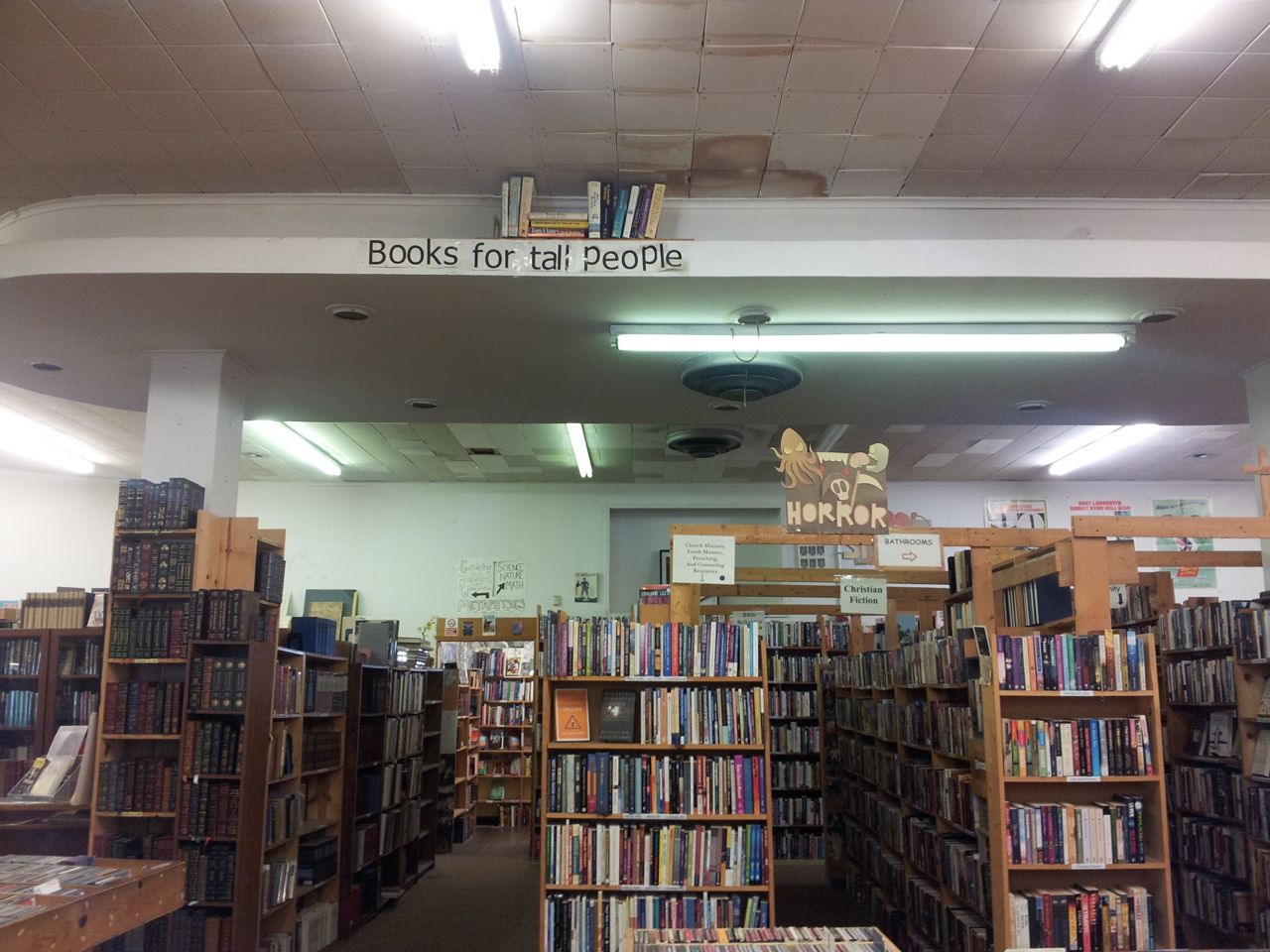
Recycled Books - Denton, TX
Recycled Books – Denton, TX

Used books are the best because many come with their original stories and the stories of their previous owners. You never know what unexpected tales you’ll find tucked inside a previously owned book. Bookmarks, postcards, love notes, grocery lists, phone numbers, photographs, insane ramblings in the margins—it all tells a story.

Just last Friday, I visited the wonderfully-peculiar and many-leveled Recycled Books in Denton with the wonderfully-peculiar and many-faceted Annie Neugebauer. We were sitting on the yellow shag carpeting in front of the Ray Bradbury shelf, smelling books and discussing horror magazines and the pronunciations of German last names when Annie opened a book to find this gem:

Photo courtesy of Annie Neugebauer, who is now the proud owner of Bradbury’s The Illustrated Man, a couple of jellyfish, and a whole lot of lime (Lyme?) disease.

I don’t know what that book’s story is. I just know that our laughter from the floor of Recycled Books is now a part of it too.

“Stories don’t end with writers.” Patrick Ness was right. All writers really do is get the story started. Once they’re in the hands of readers, books soak up more worlds, more experiences, more meaning. Ness ends his note to the reader by saying, “Go. Run with it. Make trouble.” I look forward to the day when my own novels are out there making trouble in the world. I hope the stories my books tell (both the ones I write and the ones the readers find hidden inside) are good ones.

With that in mind, I guess I’d better get back to work on that novel draft.

Review: Olive Kitteridge

Olive Kitteridge
Olive Kitteridge by Elizabeth Strout
My rating: 3 of 5 stars

This is the most confusing book review I’ve ever written.

Let me start by saying that I take the Goodreads rating system literally. If you hover your little mouse over the stars, it gives you the key. One star = did not like it. Two stars = it was ok. Three stars = I liked it. Four stars = I really liked it. Five stars = It was amazing.

I’ve heard people say things like, “I have to really hate a book to give it less than three stars,” and, “You only gave it three stars? Oh, I liked it.” These things confuse me. If I give a book three stars, then I liked it, plain and simple. My four and five star books have to earn their status.

But today, I’m having trouble with the star system, because I did not “like” Elizabeth Strout’s Pulitzer Prize winning book Olive Kitteridge. I did not enjoy it. It did not make me happy. But it was an extremely well-written novel that provoked many emotions in me, and for that I commend Strout. If I could simultaneously give it 4 ½ stars for quality and 1 ½ stars for enjoyment, I would. Lacking that type of complicated system, I gave it a three.

Warning: A few small spoilers beyond this point.

Olive Kitteridge is a very depressing book. The story weighs heavy on my mind and my heart. I am certain that if I’d read it ten years ago (yes, I realize it wasn’t written then) I wouldn’t have made it past the point in the very first story where the young grieving widow accidentally runs over her new kitten. I’m not a fan of stories in which animals die; in fact, I avoid almost any book with a cat or a dog on the cover for that very reason.

I did make it past the poor kitten’s death (I guess I’m older and wiser and maybe my heart has toughened a bit), but I’m quite sure that if I’d been reading the print version of this novel, rather than listening to the audio book, I would’ve had to put it down somewhere around “A Little Burst” and read something else for awhile. There’s a good chance the break might have been permanent. But by listening to the stories with one ear while running errands, I was able to continue. (It also helped that when I got home I could read a happier book. If you’re going to start Olive Kitteridge, I recommend reading The Rosie Project by Graeme Simsion simultaneously for emotional balance.)

Although the audio version of the book undoubtedly took some of the sting out of some of the stories (it’s hard to cry about a woman’s loneliness in the wake of her husband’s stroke while driving beneath a blue sky past fields of wildflowers), I still almost turned the thing off when I finished “Security.” The end of that story—the inability of a mother and her son to properly communicate, the upset that resulted, the way they left things—just broke my heart.

Heartbreak, though, is a powerful emotion; my need to punch my car stereo’s off button is evidence of Strout’s excellent writing. She gives life to every single character, paints a vivid picture of a small Maine town through snippets weaved through a dozen tales, and tackles the complexity of the human spirit with absolute fearlessness. For that, she deserves her prizes.

The thing is, in the end, I still enjoy a story with a little more light in it. A little more joy, a little more hope, a little more humor. If a a book is going to reduce me to tears, I want it to be done delicately, with the poetry of The Book Thief or the passion of The Fault in Our Stars. So I can’t, in good conscience, recommend Olive Kitteridge. It was good, but I didn’t like it.

A few final thoughts on Olive herself:

* I did not dislike Olive at any part of the book. Yes, she was moody and had a callous way of speaking and could be extremely stubborn. I’m not saying the woman had no faults; she had many. But I didn’t dislike her for them. Before reading the book, I heard from friends and strangers on Goodreads that the main character was not a likable person. For that reason alone, I feel a great sympathy for Olive. In some ways, she reminds me of myself. In my opinion, she’s got enough problems in her (fictional) life without having her readers judge her so harshly.

* One of the things that I loved about Olive was her relationship with her dog. The dog, as far as I can remember, was never given a name or a breed or even a color, but he was there, riding around in her car, shedding hair everywhere, sharing her donut holes, licking Henry’s hand in the nursing home. It would not be unusual for a woman as fastidious as Olive, who has such little patience for small children and such strong opinions about others’ homes, to also lack affection for pets. But there’s the dog, always with her, obviously loved. I’ve already mentioned my aversion to books where the pets die, so when this depressing novel introduced a beloved dog to the lonely old main character, I braced myself for its inevitable demise, expecting that the death, when it came, would be horrible. I waited and I waited and I wondered and I hypothesized, and what does Strout do? She never kills off the dog! Multiple deaths and funerals and suicides and emotional casualties in this book, but the damn dog lives. Rather than seeing this as a mercy on the part of the author, I instead view it as a new and unique form of torture.

* It is not fair for a book to mention donuts as much as this one did. I blame Olive Kitteridge for any weight I gained in the past two weeks.

[NOTE TO LOCAL READERS: Elizabeth Strout is coming to Book People this week! Tuesday, April 15th, 7pm. Click here for details.]

View all my reviews