
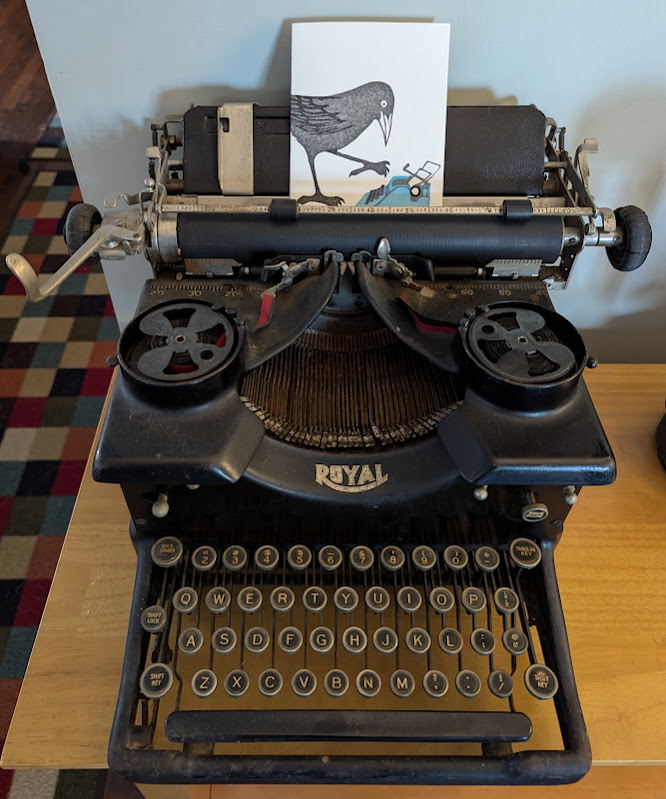
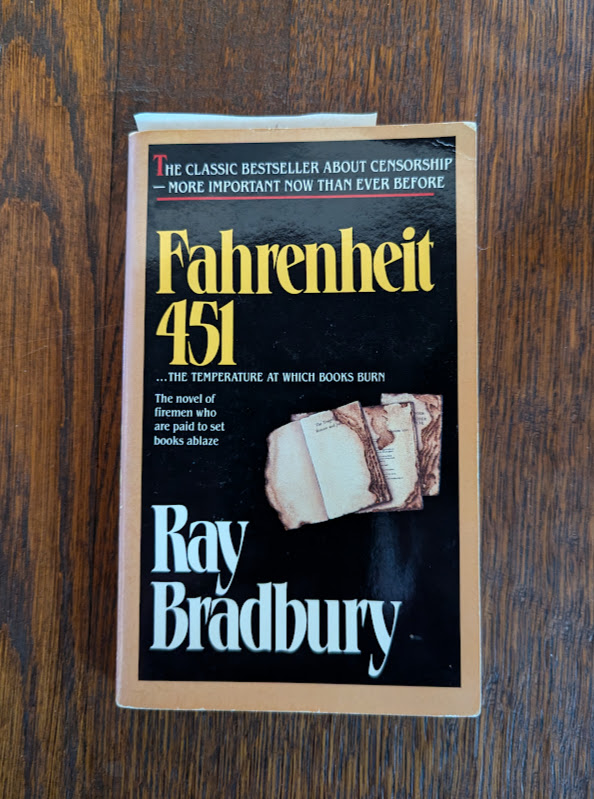
Ray Bradbury wrote Fahrenheit 451 on a pay-by-the-dime typewriter in the basement of a library in 1950. Maybe there was a painting on the wall in front of him. Maybe he had a dictionary or an encyclopedia open on his table while he worked. Maybe there was a shelf of books nearby whose spines interested him. Maybe someone he knew walked in from time to time and said hello.
But what if…
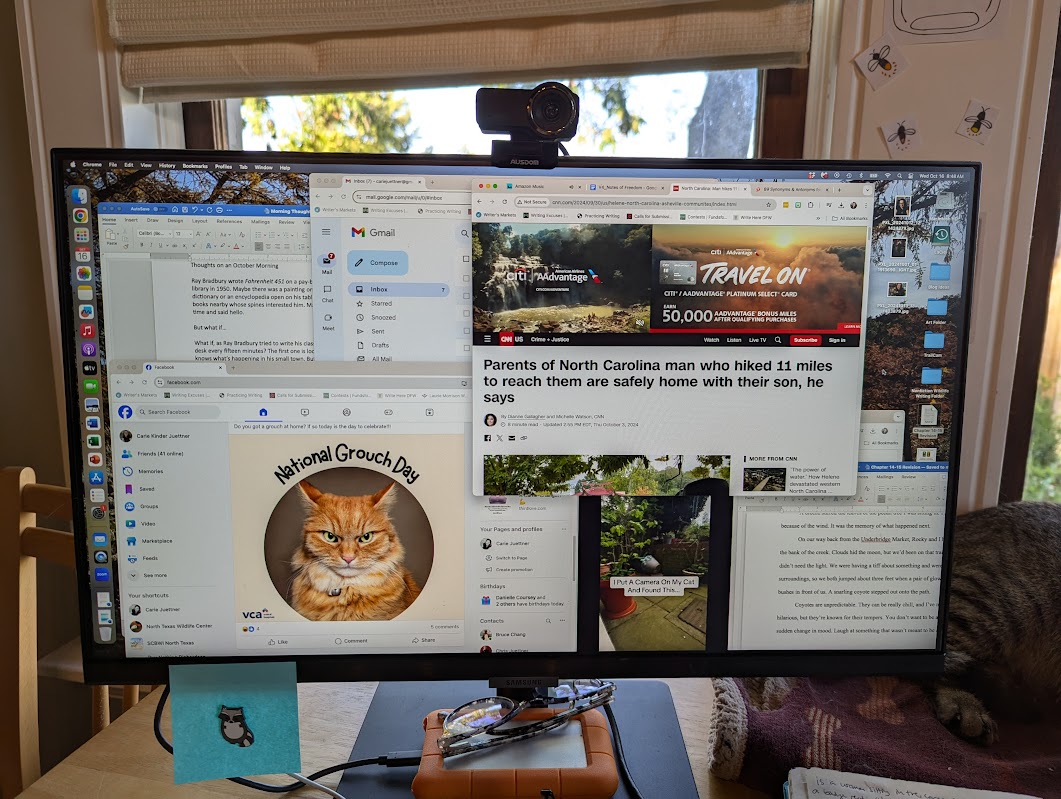
What if, as Ray tried to write his classic dystopian novel, a newspaper landed on his desk every fifteen minutes? The first one is local news, and he ignores it because he already knows what’s happening in his small town. But the next one is national news, and the next covers the upcoming election from and angle he hasn’t seen before. The one after that is from London, the following one from China, then Russia. Then a local newspaper from a village in Peru where a beautiful bird he never knew existed is on the verge of extinction.
What if there was a window in the room where Ray wrote? People he knows walk by outside. They are people he has not seen in years, even decades. Some wave, some stop and watch him type, some hold up signs at the window saying, “Hi! How are you? Remember that time we went fishing and you fell in the lake?” Now Ray is remembering it and feeling amusement, nostalgia, gratitude, and regret all rolled into one.
Perhaps Ray Bradbury was not alone in the room. Picture a woman in one corner in a white lab coat with a placard in front of her reading, Doctor/ Scientist/ Engineer/ Specialist in the fields of botany, meteorology, and machinery. In another corner sits a woman whose badge says, “Professor of History, 1500-Present.” A man in the third corner of the room wears a smug look and a t-shirt proclaiming, “EXPERT IN EVERYTHING. ASK ME ANYTHING.” He does not look especially trustworthy, but the compulsion to ask him a question is strong regardless. In the fourth corner of the room is a sleeping kitten. Every five minutes, it wakes up and runs in adorable circles for fifteen seconds before settling back down into a purring pile of fur.
Imagine that a man carrying a tray of items walks by. They are pieces of fruit made of plastic and they are for sale. Ray ignores him. The next time he comes through, the trinkets are shaped like trees instead. Ray gives them a cursory glance and keeps typing. The next time the salesman appears, the trinkets are made of crystal and formed into cats and snowmen. Ray picks a couple up, puts them down again, waves the man away. But the next time he walks by, his tray is full of wooden trinkets, carefully carved and painted into black cats, orange pumpkins, and yellow moons. He sets the tray next to Ray’s typewriter and waits.
More dictionaries and thesauruses and encyclopedias keep appearing on the table. A bag of unanswered mail is propped against Ray’s chair. The librarian comes in every twenty minutes with a new message. “Your wife is on the phone.” “Your dog called. He needs to go outside.” “A gentleman wants to know if you’re interested in selling your home.” “A woman from a faraway country says you have won a prize.” A coffee shop opens in the basement of the library. The smell of roasting beans and cinnamon rolls wafts through the air, and a teenager plays an acoustic guitar, butchering a song written before he was born.
What if, in the middle of these unlimited resources and constant connections, Ray Bradbury never runs out of paper, never runs out of ink, and the library never closes? Would he find himself writing his masterpiece in a utopia? Or a horror story?
***
“It was summer and moonlight and we had lemonade to drink, and we held the cold glasses in our hands, and Dad read the stereo-newspapers inserted into the special hat you put on your head and which turned the microscopic page in front of the magnifying lens if you blinked three times in succession.”
― Ray Bradbury, The Illustrated Man
“Stuff your eyes with wonder, he said, live as if you’d drop dead in ten seconds. See the world. It’s more fantastic than any dream made or paid for in factories.”
― Ray Bradbury, Fahrenheit 451
“We have too many cellphones. We’ve got too many internets. We have got to get rid of those machines. We have too many machines now.”
― Ray Bradbury
Discover more from Carie Juettner
Subscribe to get the latest posts sent to your email.
 Carie Juettner
Very good and insightful! And th
This was fun …and stressful