


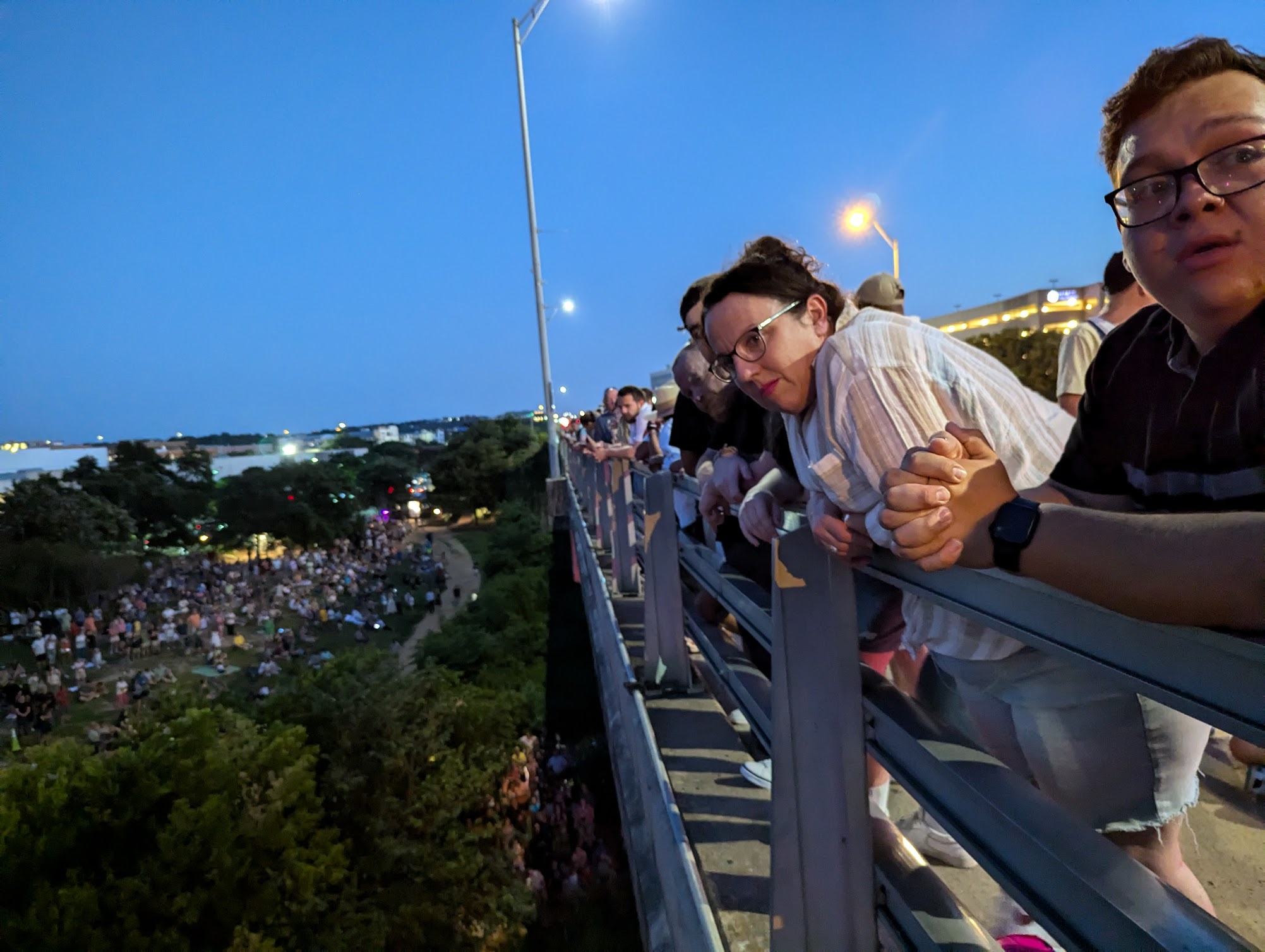
I’m standing on the Congress Avenue bridge in downtown Austin, leaning against the metal railing still warm from the just-set sun. Cars, bicycle cabs, and scooters whiz by behind me, but my eyes are focused on the water below, where kayaks of all colors gather and turn and spin like moths drawn to a neon light. We call this Lady Bird Lake, but it’s really a portion of the Colorado River, one of the few places in Austin that will stay wet and blue as summer encroaches, drying up all the creeks and backyard birdbaths.
I am shoulder to shoulder with strangers, or once-strangers anyway. Can a person really feel strange after you’ve recommended a restaurant to them or shared a laugh over a party barge filled with people dressed identically in white? (I still have no idea what that was all about. My new friend suggested maybe a bridal party. I guessed a cult.) Personal space isn’t really a thing here on the bridge, where hundreds of people are lined up, casually guarding their bit of real estate at the railing.
A woman’s dog noses the back of my leg, and when I turn to rub his ears and give him some love, she asks, “What’s everyone lined up here for?” I smile and explain, “We’re waiting for the bats.”
Austin is home to the largest urban bat colony in North America. At least 100,000 Mexican free-tailed bats (also called Brazilian free-tailed bats by some sources) nest beneath the Congress Avenue bridge year-round, with up to 1.5 million cozying up in the cervices under the road during peak season. Most days at dusk, the bats emerge and fly east down the river in search of insects. On nights when all 1.5 million take flight at once, it’s an unparalleled and astonishing sight to behold.
We already know tonight’s experience won’t be like that. It’s too early in the year and not hot enough yet. The best time to catch the big show is in late July and August when the searing Texas temperatures make it a lot less comfortable to stand beneath the setting sun for an hour. In late June, when the highs are still relatively mild and the summer drought hasn’t arrived yet, we’ll be lucky to see 20,000 bats, if they even emerge at all. But here we are—the sightseers on the bridge, the picnickers on the grassy shore below, the kayakers in the water, even the bridal party and/or cult on the barge—waiting patiently just in case.
This is my favorite thing about going to see the bats. Well, my second favorite thing. When you actually get it right—choose the right day in the right season and arrive at just the right time to grab a spot at the railing and see all 1.5 million flying mammals stream out into the night sky and swoop down the river as one big flapping cloud—there’s really nothing like that. It’s been over twenty years since I’ve witnessed the phenomenon firsthand, and I still remember the awe I felt. But my second favorite thing about bat-watching, the thing that happens every time whether the bats actually emerge or not, is the experience: the people, the patience, the shared optimism, the weirdness.
Against my right shoulder is a chatty couple from California visiting Austin after attending a wedding in Dallas. On my left, a young guy and his dad stand quietly watching the boats below. At some point I mention to the chatty Californians that I went to UT. Later, the young man on my left politely asks me if I had a good experience there, telling me he’s transferring in next fall. The woman with the dog has agreeably plopped down on the curb with her friend to wait with us. They are not in a hurry to go wherever they were originally headed, trusting that this is something worth staying for. Or could be. A person might stand here for an hour and not see any bats, but they definitely won’t see any if they’re not on the bridge. (Or under it. But it smells a lot more like bat guano under it.)
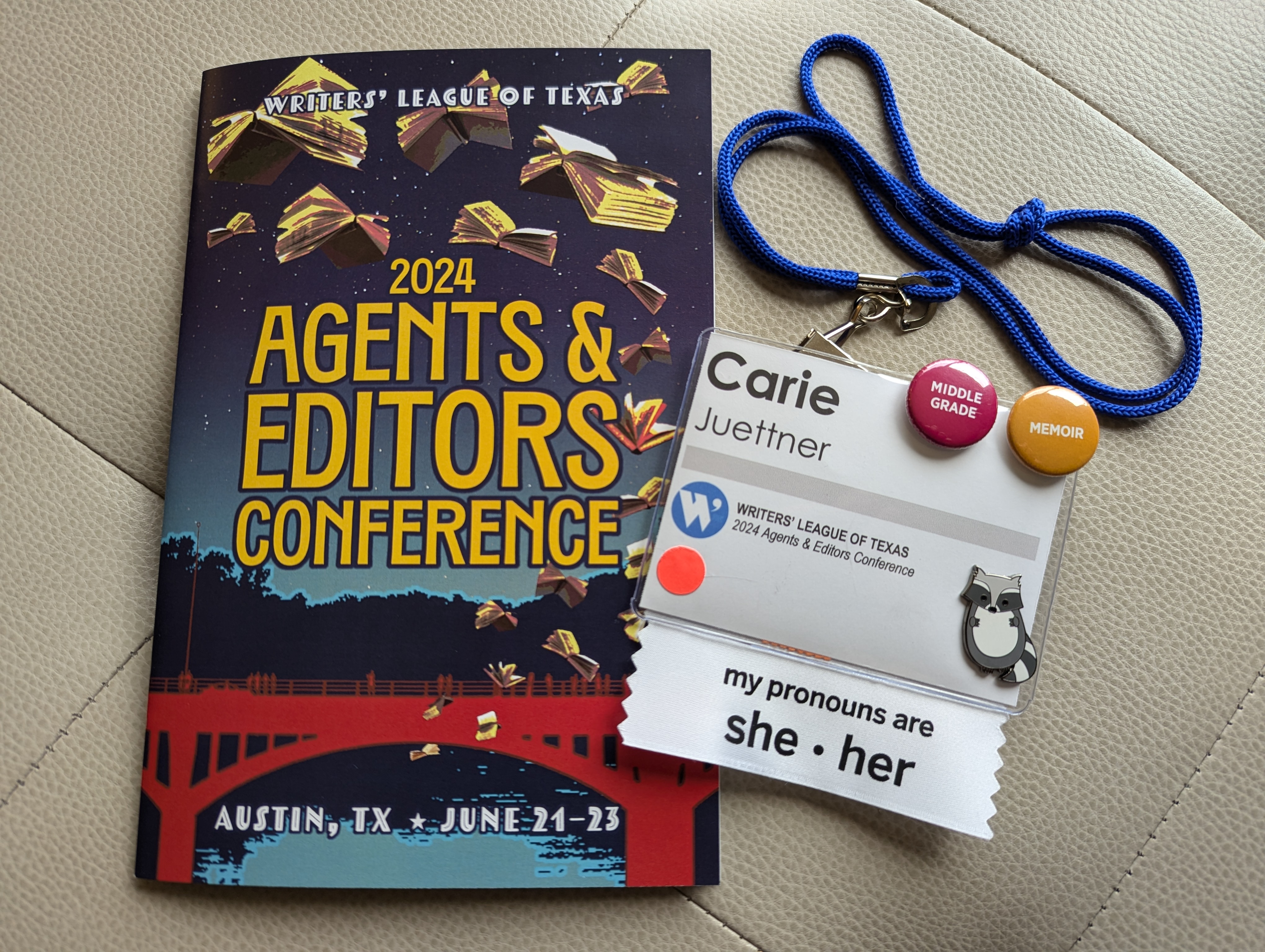
This lovely blend of optimism and realism reminds me of my reason for visiting Austin in the first place. I came back to this city where I lived for so many years for the Writers’ League of Texas Agents and Editors Conference, a semi-annual event that I’ve attended before and which never disappoints. The WLT conference brings together hundreds of authors and publishing industry professionals for three days of presentations, panel discussions, consultations, and plenty of time to mix and mingle in between. It’s an excellent opportunity for writers seeking representation for their manuscripts to learn more about the business side of writing, pitch to agents, and network with other people who love books as much as they do.
Without going into a bunch of detail, the publishing industry is “a bit of a mess right now,” to quote one panelist from the conference. Between layoffs, strikes, book bans, declines in sales, and a constant shift in personnel at various literary agencies, it’s a hard time to be pitching a book, whether you’re an author pitching an agent, or an agent pitching a publisher, and no one at the conference shied away from that reality. Everyone I listened to admitted things are difficult and shared the challenges experienced from their particular seat in the arena. But they also shared their passion for stories, their dedication to the creators of those stories, and their commitment to getting worthy stories into the hands of readers.
Most of the writers I met over the weekend were, like me, seeking an agent for their manuscript. We know it’s difficult to break in at any time, especially right now. We know that it takes more than just skill to publish a book through traditional means. It takes patience, perseverance, and a little luck as well. But that’s not stopping us from trying. Maybe we won’t meet our agent at this conference. Maybe the current book we’re working on isn’t “the one” that will get us to the shelves of BookPeople. But we’re here, putting in the work, making the connections, taking the chances, and meeting a lot of friends along the way. In other words, we’re staying optimistic. We keep coming to the bridge.
A little after 9:00pm when it starts to feel like those of us on Congress Avenue are all part of a collective snipe hunt, just as the light slips into full-on dusk mode, the sky a deep gray blue, the trees black silhouettes against it, some bats begin to emerge. Not 1.5 million. Not by a long shot. A few thousand bats swarm out from the recesses beneath the bridge and dart around in circles before flying off, flitting faster than the eye can track them, not much more than blurry shadows in the edges of our vision. I have to relax my gaze like I’m staring at one of those magic eye pictures from the 90s, looking through the bats rather than at them, allowing their movement to leave a visual impression in my mind. It’s not the awe-inspiring swarm I remember from so long ago, but it’s still a very cool sight.
Several of the kayaks have drifted away by now. Some of the picnickers have packed up and gone home. A few of my fellow bridge-dwellers have wandered off. But those of us who stuck it out got to see the bats’ blurry shapes change the texture of the darkness. If we keep coming back, if we find ourselves in the right place at the right time, if we wait them out even in the heat, someday we’ll see all 1.5 million. All we need is patience, perseverance, and a little luck.
***
* Learn more about the Congress Avenue Bridge bat colony.
* Learn more about the Writers’ League of Texas.
Discover more from Carie Juettner
Subscribe to get the latest posts sent to your email.
 Carie Juettner
Great story! I’d say great allegory but I’m not sure I’m choosing the correct term. 🙂
Thank you! I’m not sure if allegory is exactly the right word, but you’ve made the right word fall out of my head.
The word we are looking for is analogy. It just came to me. 😂